

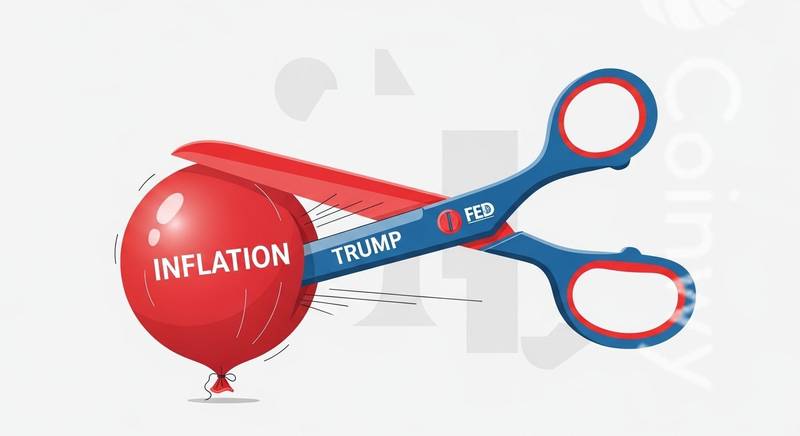
President Donald Trump has publicly called on the Federal Reserve to cut interest rates, escalating a clash with the central bank at a time when tariff-driven inflation risks are pushing policymakers in the opposite direction.
Trump posted his demand on Truth Social, urging lower borrowing costs to offset what he described as a looming economic slowdown. The call came while the Fed’s benchmark rate sat at 4.25%-4.50%, a level the central bank has held as it watches inflation data for signs of sustained progress toward its 2% target.
The Fed operates independently from the White House. While presidents can voice preferences, the central bank sets monetary policy based on economic data, not political pressure. That separation is designed to prevent short-term political interests from overriding long-term price stability.
Why Trump Is Calling for a Rate Cut Now
Trump’s push for lower rates is tied directly to the economic drag from his own tariff policies. A weaker growth outlook, with the Fed’s March 2025 projections cutting the median 2025 GDP forecast to 1.7% from 2.1% in December 2024, has raised concerns that higher trade barriers could tip the economy toward contraction.
Lower interest rates would reduce borrowing costs for businesses and consumers, potentially cushioning the blow from tariffs. They would also tend to support stock prices and broader market confidence, both politically useful outcomes.
But the logic has a flaw that the Fed itself has flagged. The same tariffs Trump wants rate cuts to offset are also pushing prices higher, creating the kind of inflation that normally argues against easing.
Tariff-Driven Inflation Limits the Fed’s Options
Fed Chair Jerome Powell addressed this tension directly in an April 4, 2025 speech, saying that higher-than-expected tariffs were “significantly larger” than anticipated and likely to raise inflation in coming quarters. He added that the outlook carried elevated risks of both higher unemployment and higher inflation.
Powell declined to commit to any policy direction, saying it was “too soon” to determine the appropriate path for rates. That caution reflected a central bank caught between conflicting pressures: weakening growth that would normally justify cuts, and rising prices that would normally justify holding or hiking.
The Fed’s own projections had already shifted before Powell’s speech. The March 19, 2025 Summary of Economic Projections raised the median 2025 PCE inflation forecast to 2.7%, up from 2.5% in December 2024. At the same time, the growth outlook deteriorated.
Wall Street echoed the concern. Morgan Stanley economist Michael Gapen said on April 3, 2025 that new tariffs “boost the risk of rising inflation, particularly over the next three to six months,” and that “tariff-induced inflation will keep the Fed on the sidelines.” Morgan Stanley dropped its expectation for a June rate cut as a result.
What the Standoff Means for Markets and Investors
Rate-cut expectations are one of the most powerful forces in financial markets. When traders believe cuts are coming, stocks tend to rally, the dollar weakens, and risk assets like crypto benefit from looser financial conditions. When those expectations fade, the reverse happens.
Trump’s public pressure does not change the Fed’s calculus, but it does inject political noise into an already uncertain environment. Investors tracking macro conditions should note that the Fed has signaled patience, not action, and that Wall Street consensus has moved away from near-term easing.
The practical takeaway is that rate expectations now hinge on incoming inflation data, not political statements. If tariffs push consumer prices higher through the summer, the case for cuts weakens further regardless of White House rhetoric. If inflation somehow moderates despite trade barriers, the Fed would have room to act.
For risk-sensitive assets, including crypto markets that have shown increasing correlation with macro liquidity expectations, the signal is caution. The combination of sticky inflation, political pressure on the Fed, and slower growth creates a backdrop where clarity on monetary policy may take months to arrive. Developments like the shifting sentiment in NFT markets and broader moves in institutional crypto holdings reflect this same risk-off posture.
The Fed’s next scheduled policy meeting will be the first real test of whether the data supports any shift. Until then, the gap between what Trump wants and what inflation allows remains the defining tension in U.S. monetary policy.
Disclaimer: This article is for informational purposes only and does not constitute financial or investment advice. Cryptocurrency and digital asset markets carry significant risk. Always do your own research before making decisions.
Read also :
- Indian Authorities Charge 8 in Alleged $20M Coinbase Spoofing Scam
- European Blockchain Convention returns to Barcelona as institutional capital moves to the centre of the digital asset market
- Bybit Announces Delisting of XIONUSDT Perpetual Contract
- Bybit to Delist Two Spot Trading Pairs on June 16, 2026
- US Watchdog Urges FDIC to Coordinate on Crypto Oversight