
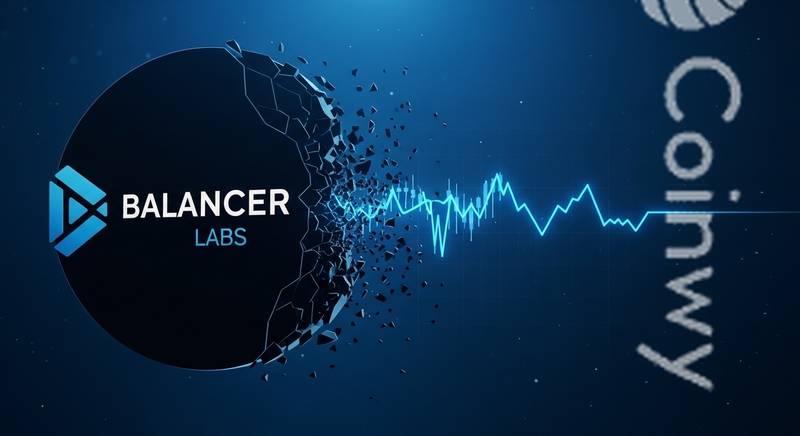
Balancer Labs, the company behind one of DeFi’s oldest automated market maker protocols, has announced it is dissolving operations as of March 24, 2026. The Balancer protocol itself will not shut down, instead transitioning to governance under the Balancer Foundation and Balancer DAO.
The announcement marks the end of the corporate entity that built and maintained the Balancer protocol since its 2020 launch. But it also tests a core premise of decentralized finance: that protocols can outlive the companies that created them.
Balancer Labs Closes: Why the Company Called It Quits
Balancer Labs described itself as “a liability rather than an asset to the protocol,” according to a report from CoinTelegraph. The company had been operating without revenue while spending on liquidity incentives that diluted BAL token holders without generating sustainable returns.
Co-founder Fernando Martinelli framed the problem bluntly.
“The problem isn’t that Balancer doesn’t work. The problem is that the economics around Balancer aren’t working.”
A $116 million security exploit in November 2024 compounded the financial strain and created what the company described as “real and ongoing legal exposure.” The hack accelerated a decline that had already been underway for years.
Balancer’s total value locked peaked at $3.3 billion in November 2021. By October 2025, it had fallen to $800 million. At the time of the shutdown announcement, TVL sat at approximately $158 million, a roughly 95% decline from peak.
Balancer Protocol — TVL Decline From Peak
~95%
From $3.3B (Nov 2021) to ~$158M (March 2026)
BAL token price reflects the erosion. At $0.1543 with a market cap of roughly $9.98 million, BAL trades more than 99% below its all-time high near $75 in May 2021. Daily trading volume hovered around $528,000.
The Protocol Survives: What Changes for BAL Holders and Liquidity Providers
The distinction between Balancer Labs (the company) and the Balancer protocol (smart contracts deployed on-chain) is critical. Balancer Labs handled core development, grants, and governance support. The protocol’s smart contracts continue to function independently of the company.
Going forward, the Balancer Foundation and Balancer DAO will manage protocol operations. Two governance proposals are pending voter approval to formalize the restructuring and revise BAL tokenomics. The transition plan includes eliminating BAL emissions entirely, restructuring protocol fees to allow the DAO to capture revenue directly, and reducing team size.
The protocol is not without signs of life. Over the three months prior to the announcement, Balancer generated more than $1 million in protocol revenue. CEO Marcus Hardt emphasized this in his statement: “Balancer still has real value to build from here…a stronger and more sustainable protocol.”
For liquidity providers, funds in Balancer pools are governed by immutable smart contracts, not by Balancer Labs’ corporate status. The immediate risk is not loss of funds but potential stagnation: without a dedicated development team, protocol upgrades, security patches, and integrations with new chains or tokens could slow considerably.
BAL holders retain governance rights through the DAO. Whether those rights remain meaningful depends on whether the community can attract and fund service providers to replace the functions Balancer Labs performed. The broader DeFi sector has seen similar corporate-to-DAO transitions, including emerging tokenized finance platforms exploring decentralized governance models from launch.
Resilience Test or Warning Sign for DeFi?
Balancer Labs is not the only DeFi company stepping back from direct protocol control. BGD Labs ceased its contributions to Aave earlier in 2026, and the Uniswap Foundation has faced its own structural questions. The pattern suggests a broader reckoning with whether venture-funded lab entities are the right long-term stewards for decentralized protocols.
The bull case: this is exactly how decentralized infrastructure is supposed to work. Protocols survive their creators. Balancer has been live for over five years since its March 2020 mainnet launch, and the smart contracts do not require a corporate entity to keep running.
Balancer Protocol — Years in Production
5+ Years
Mainnet live since March 2020 • Source: balancer.fi
The bear case: a protocol without active core developers risks falling behind. Security audits become harder to coordinate. Ecosystem partnerships dry up. Competing AMMs like Uniswap and Curve, which still have funded development teams, could absorb Balancer’s remaining liquidity providers and integrations.
BAL’s muted price reaction, up 1.71% in the 24 hours around the announcement, suggests the market had already priced in much of Balancer Labs’ decline. The November 2024 exploit and sustained TVL collapse left little room for surprise. The “protocol continues” framing appears to have tempered what could have been sharper selling pressure.
The situation echoes broader questions facing decentralized finance as institutional players increasingly enter the space. Regulatory clarity efforts and large-scale institutional crypto commitments are reshaping which protocols attract capital, and leaderless protocols may struggle to compete for attention.
What happens next depends on the two pending DAO governance proposals. If voters approve the restructuring and new tokenomics, Balancer could emerge as a leaner, community-governed protocol with a viable revenue model. If the proposals stall or fail to attract sufficient voter participation, the protocol risks a slow drift toward irrelevance, still technically alive on-chain but without the development momentum to remain competitive.
Disclaimer: This article is for informational purposes only and does not constitute financial or investment advice. Cryptocurrency and digital asset markets carry significant risk. Always do your own research before making decisions.
Read also :
- World Datacentre Summit India 2026 Opens Sponsorship, Speaking, and Exhibition Opportunities
- Binance to Support Base Network Upgrade and Hard Fork on June 25
- Florida man pleads guilty in $1.8 billion HyperFund crypto fraud case
- Bitwise CIO: Next Crypto Bull Run Will Be Slower, Less Volatile
- Crypto Market on Edge After Warsh, Trump Iran Remarks