

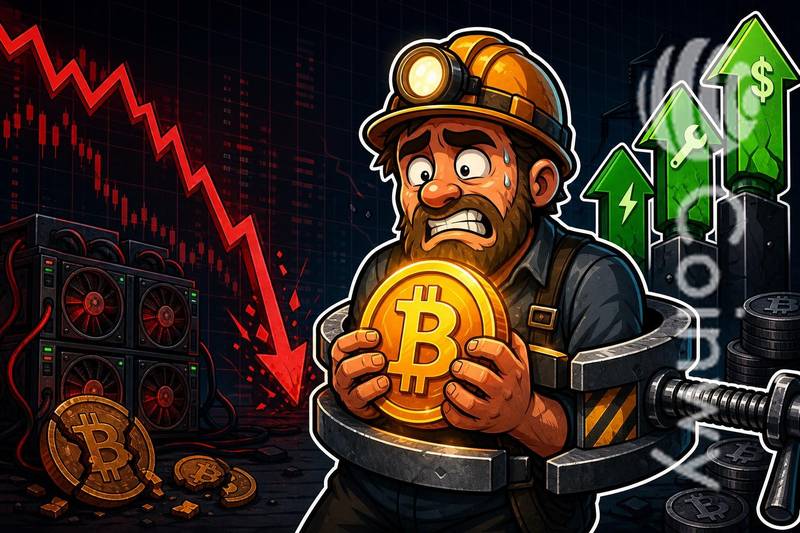
Bitcoin miners are grappling with a deepening margin squeeze as revenue from block rewards and transaction fees has fallen below the all-in cost of producing each coin, putting smaller operators under acute financial stress.
Why Bitcoin Mining Revenue Is Falling Below Production Costs
Production cost for Bitcoin miners includes electricity, hosting fees, labor, hardware depreciation, and maintenance. When the market price of Bitcoin sits below that combined cost per coin, every block mined generates a net loss on a cash basis. For related coverage, see Coinbase Board Warns 7 Million Bitcoin Could Face Future Quantum Risk.
The Block reported that miner revenue has slipped below production costs, creating a sustained period of negative margins across much of the industry. The pressure is compounded by the April 2024 halving, which cut the block subsidy from 6.25 BTC to 3.125 BTC, halving the primary income stream overnight while operating costs remained largely fixed.
A separate CoinDesk analysis noted that Bitcoin has traded below its estimated mining cost for five consecutive months, marking one of the longest such stretches on record.
KEY TAKEAWAYS
- Revenue below cost: Miner income per BTC has fallen below all-in production expenses, squeezing margins industry-wide.
- Halving hangover: The 2024 block subsidy cut halved the primary revenue source while fixed costs stayed flat.
- Smaller miners hit hardest: High-cost operators face the most immediate pressure to shut down rigs or liquidate reserves.
How Rising Costs Are Forcing Tough Operational Choices
Mining businesses cannot pause their electricity bills or hosting contracts when revenue dips. Operators running older, less efficient ASIC hardware face the steepest losses because their power consumption per terahash is higher than miners using next-generation machines.
Under sustained margin pressure, operators typically respond with a familiar playbook: upgrade to more efficient hardware, curtail expansion plans, renegotiate power contracts, or sell mined Bitcoin immediately rather than holding it on the balance sheet. CleanSpark’s widening Q2 loss after a $224 million hit on its Bitcoin holdings illustrates how treasury strategy becomes a liability when prices stay depressed.
Pressure to liquidate mined coins creates a feedback loop. When miners sell into a weak market to cover operating expenses, it adds sell-side pressure that can further suppress prices, tightening margins even more.
Energy costs remain the single largest variable. Operators in regions with cheap, stable power, such as those leveraging Texas grid frameworks, can survive longer than competitors paying retail electricity rates. That geographic cost advantage becomes existential during prolonged downturns.
What the Margin Squeeze Could Mean for the Mining Sector
Extended periods where revenue trails production costs tend to accelerate consolidation in capital-intensive industries. Weaker miners shut down rigs or sell assets, while well-capitalized firms acquire discounted hardware and hosting capacity to gain market share.
If enough high-cost miners go offline, network hash rate growth could stall or temporarily decline. That would trigger a difficulty adjustment, lowering the computational threshold for remaining miners and gradually restoring profitability for survivors. As analysts have noted, Bitcoin miners face a tougher road to the 2028 halving, and the current squeeze may determine which companies are still standing when the next subsidy cut arrives.
The broader competitive landscape is also shifting. The emerging U.S.-Russia duopoly in global hash rate means that regulatory and energy policy decisions in those two countries will increasingly shape which miners survive margin compression and which do not.
For investors, sustained miner stress signals caution around mining equities and related infrastructure plays until the spread between Bitcoin’s market price and production cost turns positive again.
Disclaimer: This article is for informational purposes only and does not constitute financial or investment advice. Cryptocurrency and digital asset markets carry significant risk. Always do your own research before making decisions.