


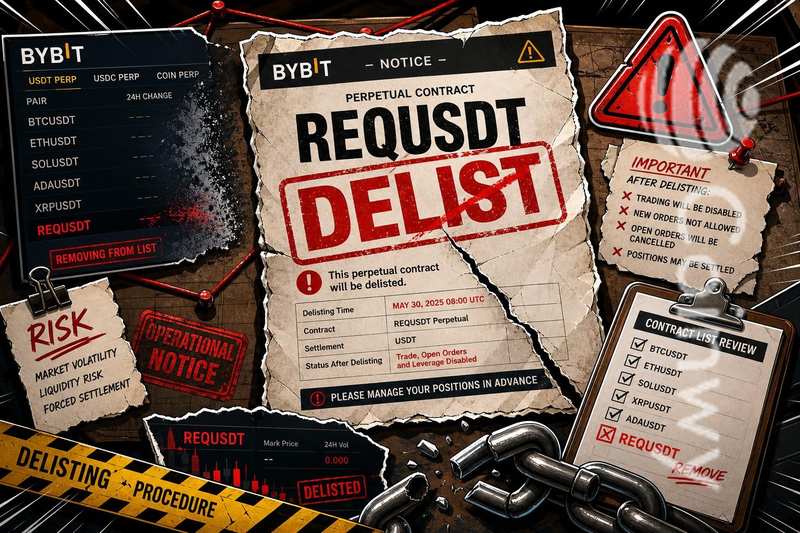
Bybit is set to delist the REQUSDT perpetual contract, removing the Request Network derivatives pair from its trading platform in a move that directly affects traders holding open positions on the pair.
The exchange posted the delisting notice through its official announcements page, which lists scheduled contract removals alongside other platform updates. REQUSDT is a perpetual futures contract tied to Request Network’s REQ token, and its removal means Bybit will no longer support leveraged trading on that pair.
What Traders With Open REQUSDT Positions Should Watch
A perpetual contract delisting directly impacts anyone with active exposure to that market. Traders holding long or short positions on REQUSDT will need to close or adjust their positions before the delisting takes effect, or face automatic settlement under whatever terms Bybit specifies in its notice.
Liquidity on the REQUSDT pair is likely to thin as the delisting date approaches. Wider spreads and higher slippage are common in the final days of a contract’s life on any exchange, which creates execution risk for traders attempting last-minute exits.
Bybit’s prior delisting notices for perpetual contracts have typically included specific deadlines and settlement procedures. Traders should consult the official announcement for exact dates and terms rather than relying on secondary reporting.
The delisting applies only to the perpetual contract, not necessarily to spot trading of REQ on Bybit. This distinction matters: holders of the underlying token on the exchange are not directly affected by a derivatives-only removal, similar to how exchange-level adjustments on platforms like Upbit can target specific product types without broader asset delistings.
Why Contract Removals Signal Shifting Exchange Priorities
Exchanges routinely trim their derivatives lineup when trading volume or open interest on a contract falls below thresholds that justify the operational and risk-management overhead. A delisting does not inherently reflect a negative judgment on the underlying project, but it does indicate that market demand for leveraged exposure to that asset has declined on that particular venue.
For niche tokens like REQ, a perpetual contract removal from a major exchange narrows the available venues for derivatives trading. Traders who want to maintain leveraged positions may need to look for the pair on other platforms, though availability will depend on each exchange’s own listing criteria.
Contract delistings can also reflect broader compliance and risk-control priorities. Exchanges operating across multiple jurisdictions, as recent events around listing standard overhauls at protocols like Aave have shown, increasingly evaluate whether maintaining certain products aligns with evolving regulatory expectations and internal risk frameworks.
The removal is part of a broader pattern across crypto exchanges, where platforms periodically review and cull low-activity derivatives pairs. Traders who encounter locked or legacy positions on any platform, much like scenarios involving funds stuck in older smart contracts, benefit from acting early rather than waiting for forced settlement.
Anyone with active REQUSDT perpetual positions on Bybit should review the exchange’s official delisting notice for settlement terms, deadlines, and any fee implications before the contract is removed.
Disclaimer: This article is for informational purposes only and does not constitute financial or investment advice. Cryptocurrency and digital asset markets carry significant risk. Always do your own research before making decisions.
Read also :
- Whitehat Developer Unlocks $2 Million Stuck in 2016 Ethereum ICO Contract
- Aave Overhauls Listing Standards After the $230 Million rsETH Exploit
- Upbit Announces GAS Airdrop Payment for the Fourth Week of May
- Coinbase Launches in India With Direct INR Payment Rails
- Sui Attributes Three Mainnet Halts to Upgrade Bugs