






Hyperliquid is the stronger choice for traders who need visible order-book depth, resting limit orders and execution that can be measured against a bid and ask. GMX is more suitable when a trader accepts oracle-priced execution against liquidity pools and can monitor price impact, pool utilization and borrow cost.
Neither venue is universally cheaper. Hyperliquid makes spread, queue position and book impact central to the result, while GMX makes open-interest imbalance, pool conditions and holding cost central. The better venue is the one whose cost model fits the intended order size and holding period.

Hyperliquid vs GMX: the structural comparison
| Comparison factor | Hyperliquid | GMX | Edge |
|---|---|---|---|
| Execution model | Onchain central limit order book | Oracle-priced positions against GM pools | Hyperliquid for price discovery; GMX for pool-based execution |
| Entry control | Market, limit, stop, scale and TWAP-style order control | Market and trigger workflows with protocol price impact | Hyperliquid |
| Visible liquidity | Bid/ask depth and displayed size | Pool composition, utilization and open-interest balance | Depends on the trader’s preferred evidence |
| Base trading cost | Maker/taker tier applied to executed notional | Usually 0.04% or 0.06% per position change in the reviewed schedule | Depends on order behavior |
| Holding cost | Funding transferred between long and short exposure | Funding plus a utilization-sensitive borrow fee | Hyperliquid for simpler carry accounting |
| Liquidation path | Position reaches the maintenance threshold, enters the book, then may use a backstop | Oracle mark, collateral value, fees and capped negative price impact determine closeout | Neither has a universal risk advantage |
| Liquidity-provider exposure | Separate market-making activity | GM and GLV holders directly absorb pool-side trading exposure | GMX offers the clearer pool product |
| Strongest use case | Active CLOB trader, passive orders, TWAP and measurable fills | Directional trader comfortable with oracle and pool mechanics | Strategy-specific |
This comparison is more useful than a generic DEX ranking because the two venues sell different execution products. A trader moving from the broader perpetual DEX selection guide should first decide whether a displayed order book or a pool balance provides the more useful risk signal.
The practical split is clear. Hyperliquid rewards traders who can read spread, depth and queue behavior. GMX rewards traders who can estimate how the same position changes open-interest imbalance and pool utilization. Comparing only headline volume hides the mechanism that actually determines the fill.
Protocol-wide activity on the Hyperliquid statistics surface and market access on the GMX public site help confirm that a product is operating, but neither establishes executable liquidity for the intended order. The comparison still has to be completed at the market, size and collateral level.
Entry and exit costs: queue position versus pool imbalance
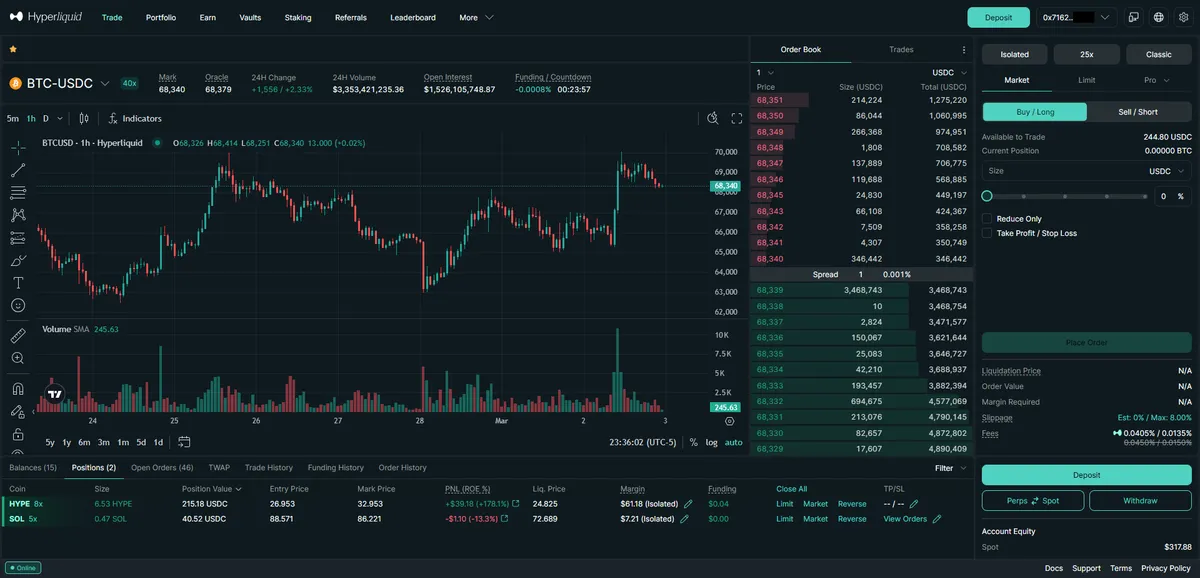
On the Hyperliquid trading interface, a market order consumes displayed liquidity and a limit order competes for queue priority. The realized cost therefore includes the account’s current maker or taker rate, the spread crossed, book impact and any difference between the first quote and average fill. A resting order can reduce explicit fees, but it also creates non-fill and adverse-selection risk.
The key advantage is auditability. A trader can record the best bid and ask, visible depth at each level, filled size and average execution price. That evidence supports a real comparison with the Coinwy liquidity and slippage analysis instead of relying on a venue-wide volume figure.
GMX does not reproduce that queue. On the GMX trading app, a position is priced from an oracle reference and then adjusted by protocol fees and price impact. Under the fee schedule reviewed on August 13, 2026, a position change generally costs 0.04% when it improves long-short balance and 0.06% when it worsens that balance. Price impact remains separate from the position fee and can help or hurt the trader.
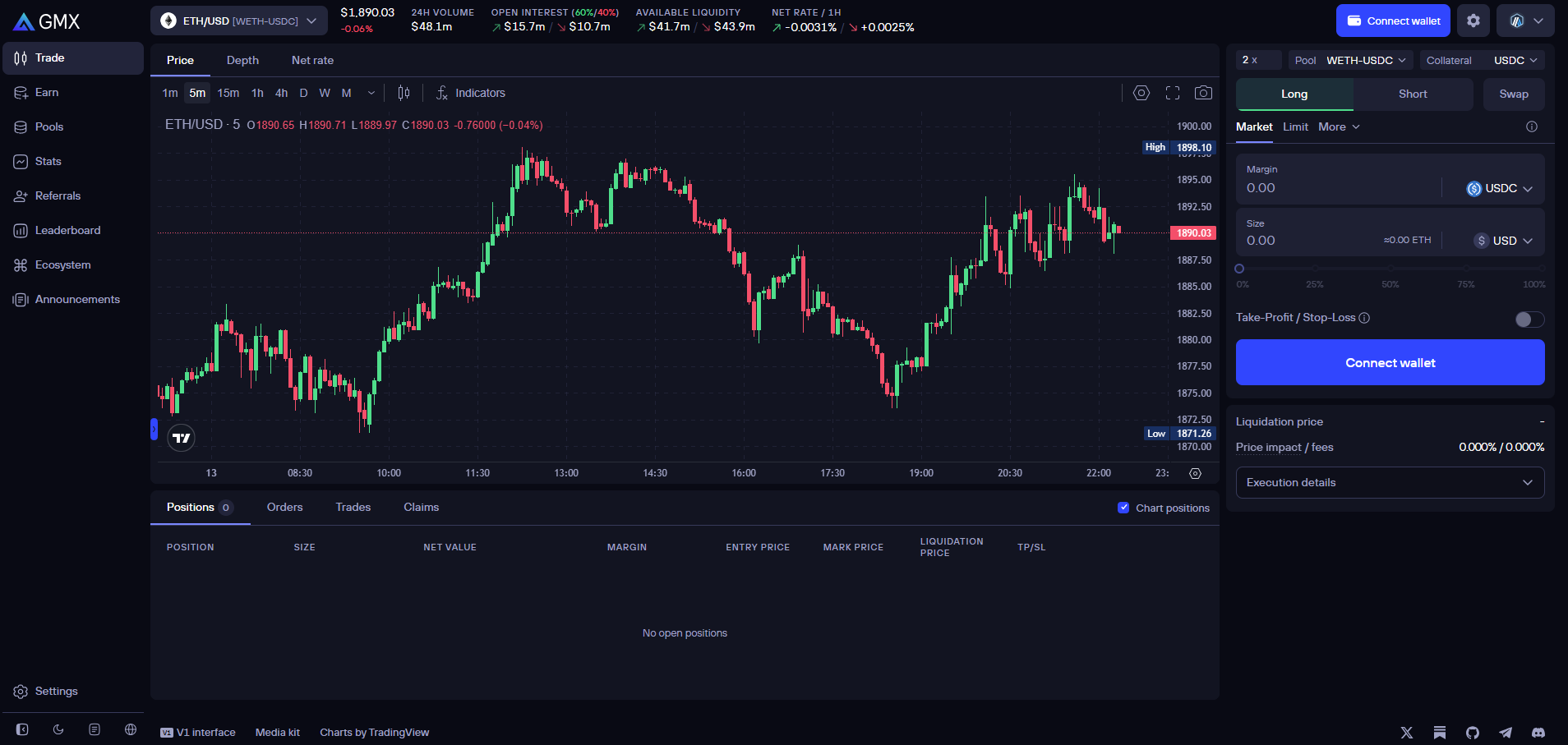
That structure can be competitive for an order that would sweep several levels of a thin book. It can also be more expensive than the headline fee suggests when the trade pushes a market farther into imbalance. GMX’s model should therefore be evaluated from the final execution price and collateral change, not from an assumption that oracle pricing means zero slippage.
The all-in cost equation for the intended order
| Cost layer | Hyperliquid calculation | GMX calculation |
|---|---|---|
| Entry | Executed entry notional x live maker/taker rate | Executed entry notional x 0.04% or 0.06% |
| Exit | Executed exit notional x live maker/taker rate | Executed exit notional x 0.04% or 0.06% |
| Price formation | Difference between mid-price and average book fill | Positive or negative price impact from open-interest imbalance |
| Time in position | Funding settled during the holding interval | Funding plus utilization-sensitive borrow |
| Capital movement | Actual deposit and withdrawal costs | Actual collateral-route and network costs |
Hyperliquid’s total cost is the two executed fees plus spread, book impact, funding and capital-movement costs. GMX’s total is the opening and closing position fees plus net price impact, funding, borrow and route costs. Using the trader’s intended notional preserves the effect of market depth; imposing one arbitrary dollar amount would conceal whether either venue can absorb the actual order.
The 0.04% GMX route has an advantage over the 0.06% route only when the trade improves the protocol’s long-short balance. Hyperliquid has no equivalent pool-balancing discount, but a passive fill can reduce its explicit charge. The comparison therefore begins with order direction and execution method rather than account size.
Holding a position: funding alone versus funding plus borrow
Hyperliquid uses a conventional perpetual funding transfer between long and short exposure. The relevant number is the cumulative funding charged or received during the planned holding interval, not one isolated rate. A trader holding through several funding updates should record the actual debit or credit alongside the entry and exit fees.
GMX adds another layer. Funding responds to long-short imbalance, while borrow cost reflects demand for the pool’s capital and can rise with utilization. A side that appears attractive from funding alone can still carry a meaningful borrow charge. This distinction makes the Coinwy funding-rate explainer especially relevant to Hyperliquid, while GMX requires funding and borrow to be tracked separately.
| Holding pattern | Hyperliquid cost focus | GMX cost focus | More suitable model |
|---|---|---|---|
| Intraday market order | Fee, spread and immediate impact | Position fee and price impact | Lowest recorded all-in entry and exit |
| Resting limit strategy | Maker rate, fill probability and adverse selection | No equivalent queue strategy | Hyperliquid |
| Multi-day directional trade | Cumulative funding | Cumulative funding plus borrow | Usually easier to model on Hyperliquid |
| Trade that reduces pool imbalance | No pool credit | Potentially lower fee and favorable impact | GMX can gain an edge |
| Crowded side in a utilized pool | Funding reflects crowding | Funding, borrow and negative impact can compound | Hyperliquid is easier to diagnose |
GMX is not automatically expensive for holding. A balance-improving position in a well-supplied pool can receive more favorable treatment than a crowded order-book trade. The point is that its carry cannot be represented by funding alone.
Margin and liquidation: two different paths to forced closure
Hyperliquid begins liquidation when account equity falls below maintenance margin. In the mechanism reviewed for this article, maintenance margin is linked to the market’s maximum leverage, which varies by asset. A liquidating position is first sent through the order book; a backstop can become relevant when ordinary book execution is insufficient.
That design exposes the trader to the same liquidity evidence used at entry. Thin depth during stress can change the liquidation result even when the calm-market spread looked narrow. The Coinwy leverage-risk guide helps translate that into a usable buffer rather than treating maximum leverage as a target.
GMX liquidation depends on oracle price, remaining collateral, accumulated fees and the negative price impact applied to closing. Parameters vary by market. The reviewed mechanism uses maintenance-style thresholds that can fall roughly between 0.25% and 1%, while liquidation fees differ for standard, synthetic and higher-volatility markets. These values must be refreshed in the selected market before publication or deposit.
The comparison changes the trader’s monitoring screen. Hyperliquid requires attention to book depth, account equity and the backstop route. GMX requires attention to oracle mark, collateral denomination, price-impact cap, borrow accrual and pool conditions. The Ostium oracle-manipulation report shows why an oracle-priced venue should be assessed through the entire price and liquidation path rather than the oracle label alone.
| Liquidation checkpoint | Hyperliquid | GMX |
|---|---|---|
| Price reference | Order-book market and protocol mark | Oracle reference with protocol adjustments |
| Main pre-liquidation signal | Account equity versus maintenance margin | Remaining collateral after loss, fees and impact |
| Execution route | Order book, followed by backstop if required | Protocol close against the pool model |
| Stress variable | Available book depth | Oracle behavior, pool imbalance and capped impact |
| Best user control | Lower leverage and isolated collateral | Lower leverage, suitable collateral and impact monitoring |
Neither venue removes liquidation risk through self-custody. Wallet control determines who signs, while the protocol still determines margin accounting and forced-close behavior.
Trading and providing liquidity are separate decisions
A Hyperliquid trader interacts with a book whose liquidity is supplied by market makers and other participants. A GMX trader faces pooled liquidity, while GM or GLV holders take a distinct exposure to trader profit and loss, asset composition and protocol fees. Trading on GMX does not provide enough evidence to recommend holding its liquidity tokens.
The GMX pool interface exposes the available liquidity products, but a pool allocation needs a separate return calculation. It should include fee income, trader PnL, token price changes, rebalancing and contract risk. Coinwy’s coverage of a shared-liquidity architecture provides useful context for why pooled capital cannot be evaluated like a simple deposit balance.
The winner changes with the strategy
| Trader objective | Better first test | Reason |
|---|---|---|
| Place and amend passive limit orders | Hyperliquid | Visible queue and order-book controls |
| Execute a scheduled TWAP | Hyperliquid | Native order workflow matches the strategy |
| Avoid sweeping a visibly thin order book | GMX | Pool model may offer a better final price for the tested size |
| Trade in the direction that improves GMX balance | GMX | Lower position fee and potentially favorable impact |
| Hold while pool utilization is high | Hyperliquid | GMX borrow can compound with funding |
| Earn from pooled counterparty exposure | GMX pool product | Hyperliquid trading does not reproduce GM/GLV economics |
A Reddit trader described Hyperliquid as fast, low-fee and similar to a centralized exchange in a first-hand execution report accessed August 11, 2026. That experience supports the appeal of the visible order-book workflow, but it does not establish the cost of a specific market or stress-period fill. The implication is narrow: traders attracted by the interface should still compare actual average execution against GMX’s pool-adjusted result.
Conclusion
Hyperliquid wins this comparison for traders whose edge depends on limit orders, queue control, TWAP execution and a cost model built around spread, fill and funding. GMX wins for traders who prefer oracle-priced pool execution and can identify trades where pool balance makes price impact and fees favorable.
The deciding record is the complete position lifecycle, not a homepage statistic. Hyperliquid should be judged by average fill against the visible book. GMX should be judged by position fee, final price impact, funding, borrow and collateral returned. The venue producing the lower realized cost with the clearer liquidation path deserves the position.
FAQs
Is Hyperliquid cheaper than GMX?
Hyperliquid can be cheaper for a maker or a liquid market with minimal impact. GMX can be cheaper when a trade improves pool balance. The correct comparison adds every fee, execution adjustment and holding charge to the same notional.
Does GMX have zero slippage?
No. GMX separates conventional order-book slippage from protocol price impact. Pool imbalance and trade size can still improve or worsen the final execution price.
Is Hyperliquid better for large orders?
It is better only when the target book has enough executable depth or the order can be worked passively. A large market order can sweep levels, while GMX may price the same size differently through its pool model.
Which venue is easier for a trading bot?
Hyperliquid offers the more familiar order-book state for limit, cancel and execution logic. GMX requires the bot to model oracle price, impact, funding and borrow. Coinwy’s automation coverage explains why operational controls remain necessary even when order submission is automated.
Disclaimer: This article is for informational purposes only and does not constitute financial or investment advice. Cryptocurrency and digital asset markets carry significant risk. Always do your own research before making decisions.
Related: Hyperliquid vs dYdX in 2026: Liquidity, Fees and Decentralization



