


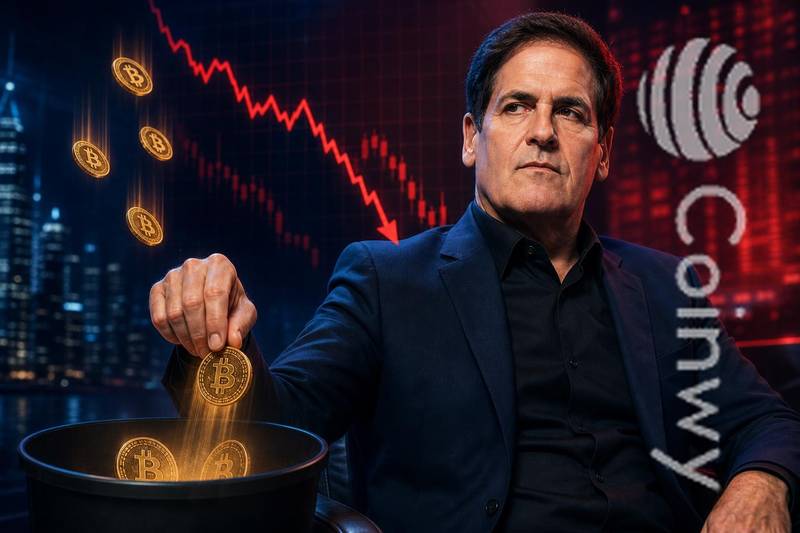
Mark Cuban has said he sold most of his Bitcoin holdings after concluding that the cryptocurrency’s narrative as an inflation hedge failed to hold up. The statement from the billionaire investor and Dallas Mavericks owner marks a notable shift from his earlier public stance on Bitcoin’s long-term value.
KEY TAKEAWAYS
- Mark Cuban said he sold most of his Bitcoin after the hedge narrative failed to materialize.
- His shift follows years of publicly supporting Bitcoin as a store of value and safe haven.
- The comments highlight how narrative durability shapes real portfolio decisions in crypto.
What Mark Cuban Said About Selling His Bitcoin
Cuban’s comments center on a single thesis: Bitcoin did not perform as the safe-haven asset many of its proponents claimed it would be. Rather than holding through volatility on the basis of that narrative, he chose to exit most of his position.
The move is striking given Cuban’s prior public support for Bitcoin. In a January 2021 interview, Cuban spoke favorably about Bitcoin and digital assets, telling CoinDesk that the upside was “truly unlimited” and expressing broad optimism about the crypto space.
Later that year, he went further. In October 2021, Cuban described Bitcoin as the “safe haven of crypto,” noting on CNBC that it had a unique advantage as a store of value within the digital asset ecosystem.
As recently as late 2022, Cuban continued to defend Bitcoin publicly. He argued in favor of the asset and criticized gold as an investment alternative in a Fortune interview, suggesting crypto remained the better bet.
Why the Hedge Narrative Failed for Him
The “hedge narrative” refers to the widely promoted idea that Bitcoin functions as a hedge against inflation, currency debasement, and macroeconomic instability, similar to how gold has traditionally been viewed.
Cuban’s stated reason for selling was that this thesis did not materialize in practice. When traditional markets experienced stress, Bitcoin did not reliably move in the opposite direction or hold its value as proponents had predicted.
This is Cuban’s individual assessment, not a universal verdict on Bitcoin’s utility. Many institutional holders and Bitcoin advocates continue to maintain the hedge thesis, while others have similarly questioned it based on Bitcoin’s correlation with risk assets during market downturns.
What Cuban’s Bitcoin Exit Could Signal for Investors
When a high-profile figure like Cuban publicly reverses course on an investment thesis, it can influence how retail and institutional participants evaluate their own positions. His comments add to an ongoing debate about whether Bitcoin’s value proposition rests on being “digital gold” or something else entirely.
The broader crypto market continues to evolve on multiple fronts. Exchanges are pushing into new regulated markets, with Kraken recently securing a broker-dealer license in Dubai, while enforcement actions like Missouri’s lawsuit against a crypto ATM operator over fraud claims highlight increasing regulatory scrutiny.
Meanwhile, trading platforms are actively adjusting their token listings. Bybit’s recent decision to delist several tokens reflects how exchanges are tightening standards as the industry matures.
Cuban’s exit does not define the Bitcoin market. One portfolio decision, even from a billionaire, does not override the asset’s fundamentals or its broader adoption trajectory. What it illustrates is that investment narratives in crypto require continuous scrutiny, and the durability of a thesis matters as much as the thesis itself.
Disclaimer: This article is for informational purposes only and does not constitute financial or investment advice. Cryptocurrency and digital asset markets carry significant risk. Always do your own research before making decisions.
Read also :
- Gemini Enables Direct USDT0 Deposits and Withdrawals
- Kraken Secures Dubai Approval for Broker-Dealer and Investment License
- Missouri AG Sues CoinFlip Operator Over Crypto ATM Fraud Claims
- Bybit to Delist AMI, BDXN, ONE, SIS, XEM and INSP
- WEMADE Signs MOU With NICE I&T to Build Web3 Payment Infrastructure