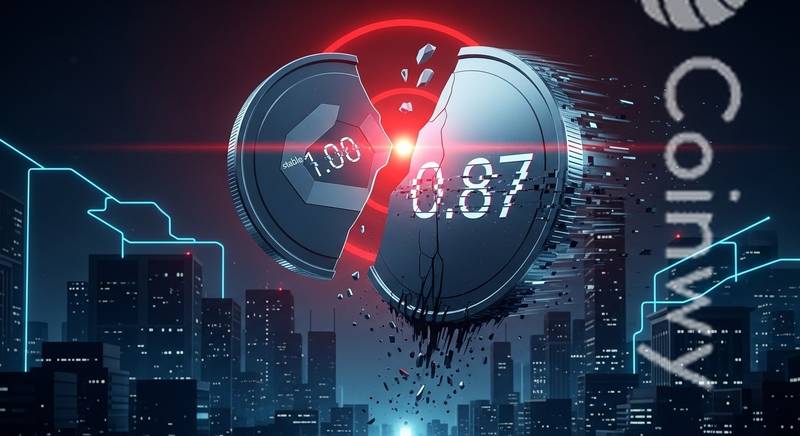
Resolv Labs’ USR stablecoin lost its dollar peg after an exploit that saw at least 80 million unbacked tokens minted, sending the token’s price plunging nearly 47% and triggering acute liquidity stress across decentralized trading pools.
A stablecoin depeg occurs when a token designed to hold a fixed value, typically $1, trades significantly below that target. In USR’s case, the break was severe and rapid, driven directly by an exploit that flooded the market with tokens that had no collateral backing them.
Even short-lived depegs can erode confidence in a protocol and drain liquidity as holders rush to exit. For USR, the damage was compounded by the scale of the unauthorized minting, which overwhelmed the token’s market structure within hours.
On-chain evidence points to 80 million unbacked USR
Blockchain records show the exploit unfolded across at least two transactions. The first, visible on Etherscan, minted 50,000,000 USR from the null address into the Resolv USR Counter contract after only 100,000 USDC moved through the system. A second exploit-tagged transaction minted an additional 30,000,000 USR.
The gap between the USDC input and the USR output is the core of the exploit. Resolv’s documentation states that minting normally relies on oracle pricing for USDC or USDT, suggesting the attacker found a way to bypass or manipulate that pricing mechanism to mint tokens far exceeding the collateral deposited.
Resolv Labs reportedly confirmed the exploit and said protocol functions were paused, according to Cointelegraph reporting that cited the team’s public statement. The pause was intended to prevent further unauthorized minting.
Market reaction was immediate and severe
USR dropped to roughly $0.5322, a 46.8% decline over 24 hours, according to CoinGecko data captured during the event. That price represents a catastrophic break from the token’s intended $1 peg.
On-chain liquidity conditions were even worse. The Curve USR/USDC pool on DEX Screener showed USR trading at approximately $0.068, a decline of over 93% with roughly $4.8 million in 24-hour volume. That level of on-chain stress suggests liquidity providers pulled out aggressively while sell pressure overwhelmed remaining depth.
The incident is a reminder that crypto exploits can inflict devastating losses in very short timeframes, whether through protocol vulnerabilities or social engineering.
What the exploit suggests about protocol risk
The exact root cause has not been confirmed by Resolv Labs or any independent security firm as of this writing. Third-party analysts, including D2 Finance, have floated hypotheses ranging from an oracle issue to a signer compromise or missing amount validation in the minting process.
D2 Finance described the attacker’s behavior after the exploit as a “textbook DeFi hack cashout running at full speed,” suggesting the funds were being moved and converted rapidly through established laundering routes.
Some estimates have placed the attacker’s extracted value at around $25 million, though that figure, attributed to D2 Finance in media coverage, has not been independently confirmed through primary wallet accounting. The actual loss could differ depending on how much USR the attacker was able to convert before liquidity dried up and the protocol was paused.
The incident raises familiar questions about smart contract security that have recurred across DeFi. As regulatory frameworks for crypto continue to develop, exploits of this scale tend to intensify scrutiny on whether decentralized protocols have adequate safeguards, audits, and emergency response procedures.
What users and the wider market will watch next
The most immediate concern for USR holders is whether redemptions will be honored and at what value. With protocol functions paused, users cannot mint or redeem tokens, leaving those with exposure unable to exit through the protocol itself.
Resolv Labs has not yet published a detailed postmortem or disclosed a confirmed loss figure. The speed and transparency of that disclosure will likely shape whether the project retains any credibility. In past DeFi exploits, projects that communicated quickly and offered clear remediation plans fared better in recovering user trust than those that went silent.
Whether USR can repeg depends on several factors: the actual size of the collateral shortfall, whether the team can recover any stolen funds, and whether remaining reserves are sufficient to back outstanding tokens once the exploited supply is addressed.
Broader market participants will also be watching for contagion. USR’s market cap sat at roughly $97.6 million before the exploit, making it relatively small in stablecoin terms. But the principle matters. Every stablecoin exploit, regardless of scale, tests the market’s confidence in the broader category, particularly as governments worldwide weigh stablecoin regulation.
For now, USR holders are left waiting for answers. The on-chain evidence is clear about what happened. What remains uncertain is whether Resolv Labs can explain how it happened and what comes next.
Disclaimer: This article is for informational purposes only and does not constitute financial or investment advice. Cryptocurrency and digital asset markets carry significant risk. Always do your own research before making decisions.
Read also :
- CoinDCX Founders Questioned as Exchange Blames Impersonation Scam
- Brazil’s New Finance Minister Puts Crypto Tax Policy on Pause: Report
- SEC Crypto Guidance Is a Major Step, but More Is Needed: Analyst
- Hong Kong Police Warn After Retiree Loses $840K in Triple Crypto Scam
- Bitcoin Mining Difficulty Drops 7.7% After Major Retarget