

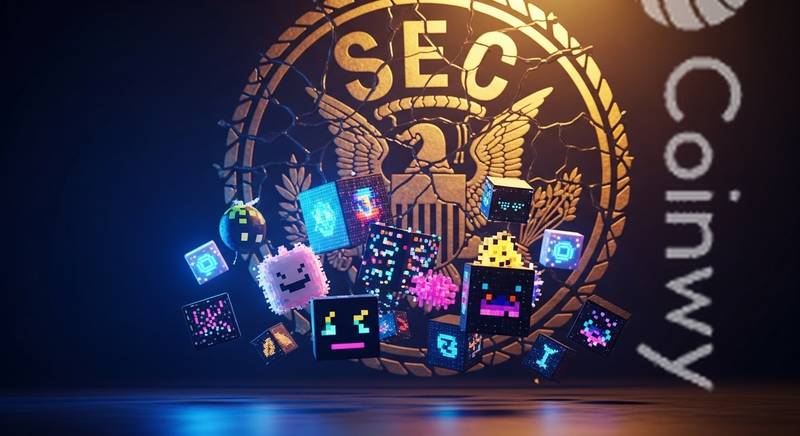
SEC Commissioner Hester Peirce argued in May 2025 that many NFTs, particularly those with creator royalty features, do not meet the traditional legal definition of securities. Her remarks offer the clearest signal yet from a sitting commissioner on how federal securities law should treat non-fungible tokens, though they stop well short of binding guidance for the industry.
Why Peirce Says Many NFTs Do Not Look Like Securities
In remarks delivered on May 19, 2025, Peirce laid out a framework centered on traditional securities-law concepts: economic rights, investment contracts, and consumptive use. Her core argument is that crypto assets without economic rights in a business entity, and meant primarily for use or consumption, should not fall under federal securities laws.
The distinction matters because it separates collectible and utility NFTs from instruments that resemble investment contracts. A digital artwork purchased for its aesthetic value, or a membership token granting access to a community, does not give the holder a claim on enterprise profits. That absence of profit rights is central to Peirce’s reasoning.
Creator royalties drew specific attention. Peirce compared NFT resale royalties to royalties paid by streaming platforms to artists. In her view, a royalty flowing back to the original creator on secondary sales does not create the kind of profit interest that securities law is designed to regulate. The royalty compensates the creator, not the buyer, and does not tie the token holder’s return to a common enterprise.
It is worth clarifying that the strongest official source behind this position is Commissioner Peirce, not SEC Chairman Paul Atkins. No formal SEC-wide statement or rule has classified NFTs as a category outside securities laws. The distinction between a single commissioner’s interpretive remarks and a binding Commission action is significant for anyone relying on this guidance, especially as legislative efforts around market structure continue to evolve in Congress.
Where the Argument Gets Stronger for Bulls and Riskier for Bears
For NFT creators and platforms, the bull case is straightforward. Peirce’s remarks support non-security treatment for the vast majority of mainstream NFT models: profile picture collections, digital art, gaming items, and membership passes. If these tokens are purchased for consumption, novelty, or aesthetic value rather than investment returns, they sit outside the securities framework she described.
Industry voices have reinforced that position. OpenSea, in an April 9, 2025 submission to the SEC Crypto Task Force, argued that most NFTs are collectibles or art purchased for consumption rather than investment. The marketplace pressed the same distinction between collectibles and investment contracts that Peirce later articulated.
The bear case is equally clear. Remarks from one commissioner are policy signaling, not law. The SEC has not issued a formal rule, staff statement, or enforcement release that definitively classifies NFTs outside securities regulation. The market still lacks the kind of clear regulatory framework that institutional participants typically require before scaling operations.
Industry reaction has been cautiously positive. The remarks and OpenSea’s submission both support a narrower, use-based view of NFT regulation. But caution is warranted precisely because interpretive positioning from a single commissioner can shift with leadership changes, and the full Commission has not weighed in.
Which NFT Models Could Still Trigger Securities Concerns
Peirce’s reasoning draws a line, and some NFT structures fall on the wrong side of it. The legal picture becomes more complex when NFTs promise shared profits from royalties to multiple holders beyond the original creator. A token that distributes revenue to all holders based on secondary market activity starts to resemble a revenue-sharing instrument, not a collectible.
Lawyer Oscar Franklin Tan acknowledged the baseline is settled ground while flagging the edge cases. “The actual context is that this is not controversial, and it was never considered a security,” Tan said, referring to standard creator-royalty NFTs. But structures that give holders economic rights tied to an enterprise, or that pool proceeds and distribute them as returns, move the analysis toward investment-contract territory.
The critical variable is what rights attach to the token. A one-of-one digital artwork with a creator royalty is far from a security. A fractionalized NFT that entitles holders to a share of licensing revenue from a media catalog is a different instrument entirely. The label “NFT” tells regulators nothing about whether federal securities law applies; the underlying economic structure does.
For projects building in the NFT space, the practical takeaway is structural. Consumptive tokens with creator-only royalties sit in the safest zone under Peirce’s framework. Revenue-sharing models, profit-participation features, or pooled-return mechanisms carry meaningfully higher regulatory risk, regardless of whether the asset is technically non-fungible. As governments worldwide refine their approach to digital asset classification, the distinction between collectible and investment-style tokens will likely sharpen further.
Disclaimer: This article is for informational purposes only and does not constitute financial or investment advice. Cryptocurrency and digital asset markets carry significant risk. Always do your own research before making decisions.