

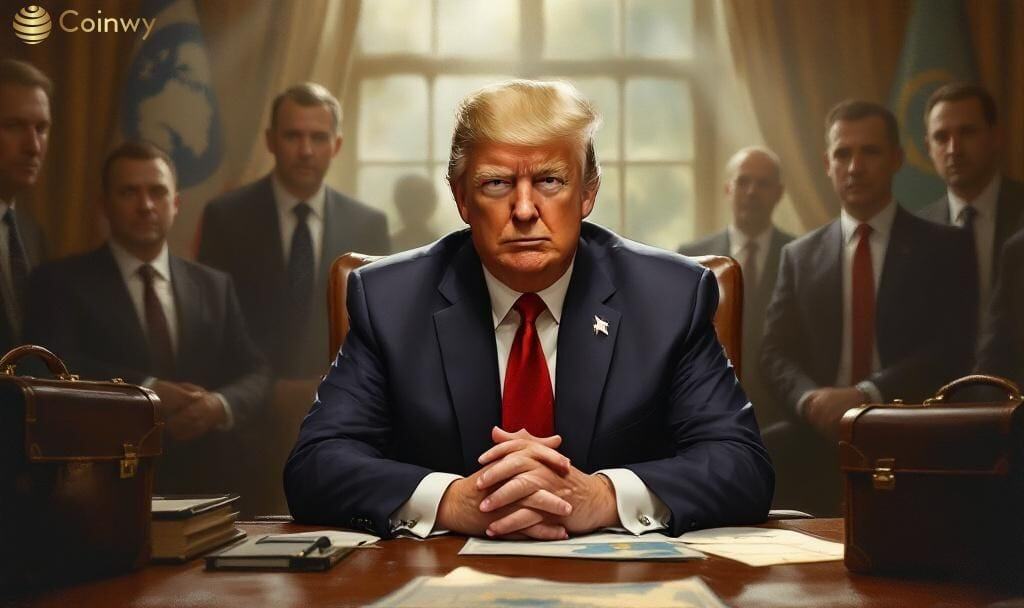
- President Trump announced tariffs to push Greenland negotiations.
- Tariffs start at 10%, rising to 25% by June.
- Europe reacts negatively to U.S. pressure on Greenland acquisition.
President Donald Trump has announced tariffs on several European countries, aiming to negotiate the purchase of Greenland, with tariffs starting on February 1, 2026.
The tariffs seek to exert pressure for a Greenland deal, impacting transatlantic relations without immediate cryptocurrency market effects.
President Donald Trump announced tariffs on European allies to pressure Denmark into selling Greenland. Starting February 1, 2026, the tariffs will begin at 10% on imports, increasing to 25% by June if negotiations fail. As Carl Bildt noted, this move could have significant implications for international relations.
The involved parties include President Trump, European nations, and their leaders. Trump argues the U.S. should control Greenland for strategic security. The bold move prompts responses from Denmark and NATO allies questioning the tariffs’ implications.
The immediate effects include strained relations between the U.S. and Europe over national security concerns. Many consider this a challenge to sovereignty and a potential blow to diplomatic ties within NATO amid ongoing Arctic military operations. Emmanuel Macron emphasized on X, “No blackmail or threat will influence us neither Ukraine, nor Greenland.”
The political and financial implications are significant. European leaders criticize the economic threat posed by the United States. Tariffs on key industries could lead to economic disruptions and shift global trade dynamics, affecting various sectors.
European nations are expected to counteract the tariffs through diplomatic and trade measures. The event might lead to reshaping alliances and global economic ties, particularly influencing European economic policies.
Historically, trade tariffs have affected international relations. Without resolution, the tariffs could lead to broader conflicts in global markets. Analysts speculate that financial turbulence may arise if Europe retaliates, creating shifts in the economic, regulatory, and strategic landscape. Acyn’s commentary also explores potential scenarios.