


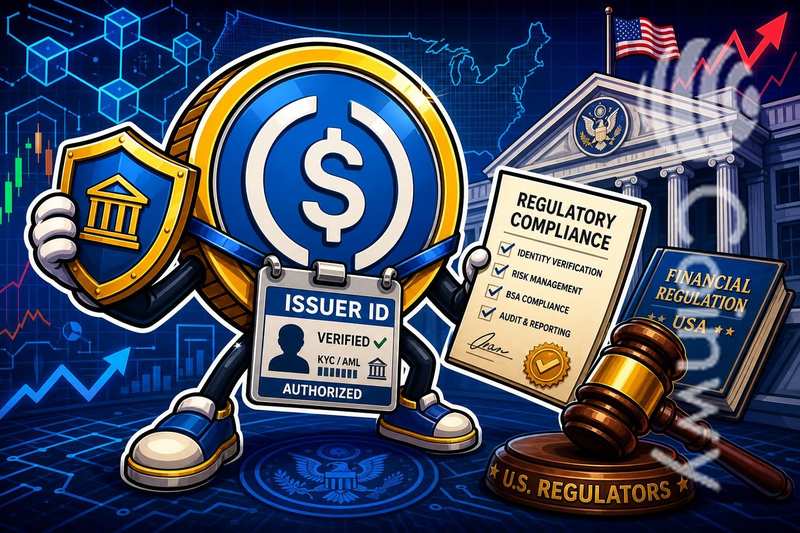
US federal banking regulators have proposed new rules that would require stablecoin issuers to implement customer identification programs comparable to those used by traditional banks, marking a significant step toward bringing crypto payment firms under the same compliance framework as depository institutions.
The Federal Reserve, FDIC, and OCC jointly published a notice of proposed rulemaking that would establish customer identification program (CIP) requirements for permitted payment stablecoin issuers. The proposal appears in the Federal Register for public inspection and would apply bank-style identity verification obligations to firms issuing stablecoins used in payments.
What Bank-Style Verification Would Require From Stablecoin Issuers
In traditional banking, CIP rules require institutions to collect and verify a customer’s name, date of birth, address, and identification number before opening an account. These requirements, rooted in the Bank Secrecy Act, form the foundation of anti-money laundering compliance across the US financial system.
The proposed rule would extend this framework to stablecoin issuers, requiring them to establish written procedures for verifying customer identities at onboarding. This represents a shift from the lighter-touch or self-regulatory approaches that many crypto firms have used to date.
KEY TAKEAWAYS
- Scope: The proposed rule targets permitted payment stablecoin issuers, not all crypto firms
- Standard: Customer identification requirements would mirror those already applied to banks
- Status: The rule is at the notice of proposed rulemaking stage, meaning a public comment period will follow before finalization
Why Stablecoins Face Heightened Regulatory Scrutiny
Stablecoins sit at the intersection of crypto markets and traditional payment rails. Because they are pegged to fiat currencies and frequently used for settlements, transfers, and on/off-ramps, regulators view them as functionally similar to bank-issued payment instruments.
That functional similarity is driving the push for equivalent controls. Anti-money laundering, sanctions screening, and fraud prevention all depend on reliable identity verification at the point of account creation, precisely the control that CIP rules enforce in banking.
The FDIC’s notice on the proposed rulemaking signals that prudential regulators are not treating stablecoin oversight as a future consideration but as an active policy priority. The distinction matters: this is about customer verification at issuance, not broader prudential supervision of reserves or capital adequacy.
The regulatory move comes as stablecoin activity continues to grow. Firms like AllUnity, which recently launched a Swedish krona stablecoin, illustrate how the stablecoin market is expanding beyond US dollar pegs and into new jurisdictions, raising questions about whether compliance standards will converge globally.
Operational Impact on Issuers and the Broader Market
Bank-style CIP requirements would increase onboarding friction for stablecoin issuers. Collecting and verifying government-issued identification, maintaining records, and implementing ongoing monitoring all carry significant compliance costs, particularly for smaller or newer entrants.
For established issuers already operating with robust KYC processes, the rule could serve as a competitive advantage. Clearer standards reduce ambiguity and may make institutional partners, including traditional financial firms expanding into digital assets, more willing to integrate compliant stablecoins into their offerings.
Partner platforms and exchanges would also feel the effects. Firms that facilitate stablecoin transactions may need to coordinate with issuers on identity verification workflows, adding complexity to existing integrations. Custody providers operating under payment licenses could find themselves better positioned if their existing compliance infrastructure already meets the proposed standards.
The proposal could also reshape competition between regulated onshore issuers and offshore alternatives. Higher compliance barriers in the US may push some activity toward jurisdictions with lighter requirements, while simultaneously strengthening the credibility of US-regulated stablecoins for institutional and cross-border payment use cases.
The rulemaking is still in its early stages. A public comment period will give industry participants, consumer advocates, and other stakeholders the opportunity to weigh in before any final rule takes effect.
Disclaimer: This article is for informational purposes only and does not constitute financial or investment advice. Cryptocurrency and digital asset markets carry significant risk. Always do your own research before making decisions.