


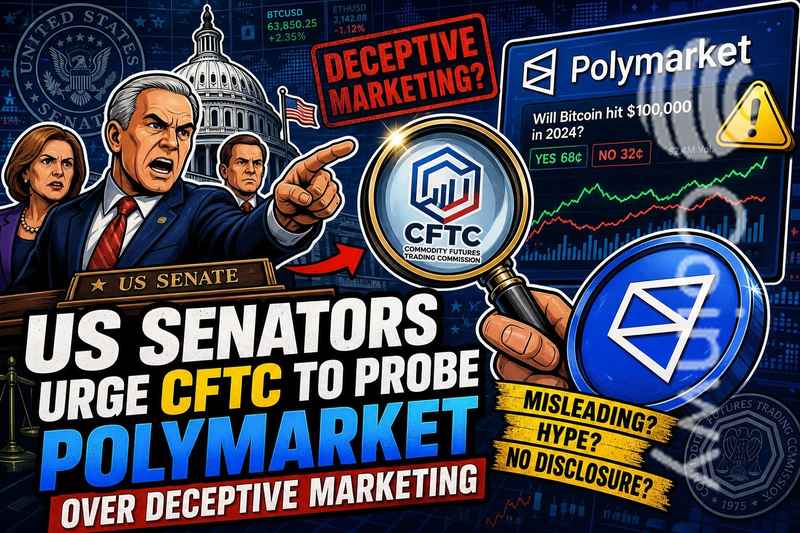
US Senators John Curtis and Adam Schiff have called on the Commodity Futures Trading Commission to investigate Polymarket over allegations of deceptive marketing, intensifying regulatory scrutiny of crypto-based prediction markets.
The bipartisan push, detailed in a press release from Senator Curtis’s office, asks the CFTC to examine whether Polymarket has misled users through its promotional practices. The senators argue that the platform’s marketing may have given consumers a distorted understanding of the risks and nature of event contracts. For related coverage, see Ark Invest Buys Coinbase, Circle, Bullish, and Robinhood Shares.
Why the CFTC Is the Regulator in the Spotlight
The CFTC oversees derivatives and event contracts in the United States, making it the natural authority for platforms like Polymarket that allow users to wager on real-world outcomes. The agency has previously taken enforcement action against Polymarket, settling charges in 2022 over the platform operating an unregistered trading facility. For related coverage, see Strategy's Enterprise mNAV Falls Below 1: Why It Matters.
That prior enforcement history makes this latest congressional pressure notable. Senators Curtis and Schiff are not asking for new legislation but rather urging the CFTC to use its existing authority to investigate whether Polymarket’s marketing materials comply with federal standards.
Key Takeaways
- Senators Curtis (R-UT) and Schiff (D-CA) sent a bipartisan letter pressing the CFTC to probe Polymarket’s marketing practices.
- The CFTC already settled with Polymarket in 2022 for operating without proper registration, giving the agency a compliance baseline.
- A formal investigation could set precedent for how all crypto prediction platforms market their products to US consumers.
It is important to distinguish between a request for investigation and a formal enforcement action. No charges have been filed, and no penalties have been assessed. The senators’ letter is a call to action, not a verdict. However, congressional pressure of this kind often accelerates agency timelines.
Prediction Markets Face a Regulatory Gray Area
Prediction markets sit at an uncomfortable intersection of finance and speculation. While proponents, including venture firm a16z crypto, have argued that properly regulated prediction markets serve a valuable information-discovery function, critics worry that platforms like Polymarket blur the line between regulated derivatives and casual gambling.
The deceptive marketing allegation centers on whether Polymarket’s promotional content adequately disclosed the risks of trading event contracts. This mirrors broader concerns across the crypto industry, where regulators in multiple jurisdictions have tightened rules around how platforms communicate with retail users.
Polymarket has also faced scrutiny beyond Congress. Reports from The Verge have highlighted concerns about fake viral video bets on the platform, raising questions about the integrity of certain markets listed on the site.
What This Means for Polymarket and the Broader Sector
A CFTC investigation, if opened, could force Polymarket to overhaul its disclosures, restrict certain promotional practices, or limit access for US users. Given that the platform already operates under a 2022 settlement, additional findings of non-compliance could carry steeper consequences.
The reputational impact extends beyond a single platform. Congressional scrutiny of prediction market marketing could prompt other crypto platforms to preemptively tighten their promotional standards. This follows a pattern seen in recent months, where Senate Democrats have also pushed for investigations into other crypto-related arrangements.
For crypto market platforms broadly, the message from Capitol Hill is clear: marketing practices are now a regulatory surface. Platforms that rely on aggressive user acquisition strategies may need to reassess how they present risk, returns, and the nature of their products to retail audiences, particularly as global regulators continue tightening compliance expectations.
Disclaimer: This article is for informational purposes only and does not constitute financial or investment advice. Cryptocurrency and digital asset markets carry significant risk. Always do your own research before making decisions.
Read also :
- Binance to Stop New Sign-Ups in Four EU States: What It Means
- Ark Invest Buys Coinbase, Circle, Bullish, and Robinhood Shares
- Strategy’s Enterprise mNAV Falls Below 1: Why It Matters
- Spain Regulator Rules Out Extension for Non-MiCA-Compliant Crypto Companies
- Ethereum Traders Show Near-Total Faith in $1,500 Floor