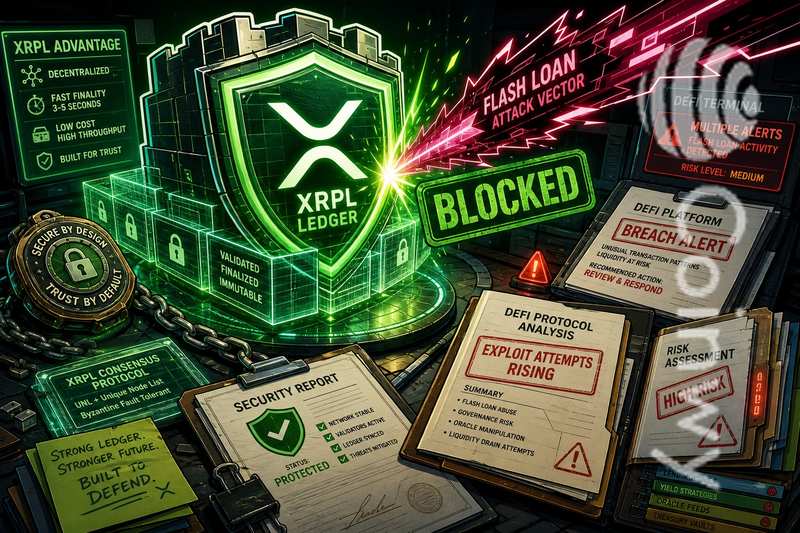
The XRP Ledger’s native architecture eliminates key conditions that enable flash loan attacks, a structural advantage gaining attention as DeFi exploits continue to drain funds from smart-contract platforms.
A recent proposal discussed within the XRPL community has renewed focus on how the ledger’s design differs from Ethereum-style DeFi stacks, where flash loan exploits have become a persistent threat.
Flash Loan Exploits Remain a Recurring DeFi Threat
A flash loan attack occurs when a borrower takes out an uncollateralized loan, manipulates asset prices or protocol logic, and repays the loan, all within a single atomic transaction. The attacker profits from the manipulation while the lending protocol sees only a completed repayment.
These attacks exploit composability, the ability for multiple DeFi protocols to interact within one transaction block. Platforms built on general-purpose smart contract environments like Ethereum are particularly exposed because any contract can call any other contract in sequence.
Security incidents tied to flash loans and similar exploit vectors have remained a consistent problem. A Q1 2026 Web3 exploit report from CDSecurity documented the ongoing scale of losses across DeFi protocols, with flash loan manipulation among the recurring attack categories. Recent incidents like the Gravity Bridge exploit that halted operations after a reported $5.4 million loss illustrate how protocol-level vulnerabilities continue to surface.
How XRPL’s Architecture Limits Flash Loan Attack Paths
XRPL was not designed as a general-purpose smart contract platform. Its transaction model processes operations through a fixed set of native transaction types rather than arbitrary programmable logic. This means the composability that flash loan attackers rely on, chaining multiple protocol interactions within a single atomic transaction, is structurally limited.
On Ethereum, a flash loan contract can borrow tokens, swap them across a decentralized exchange, deposit into a lending protocol, trigger a liquidation, and repay the loan in one transaction. XRPL’s ledger does not support this kind of unbounded intra-transaction composability.
The XRPL Standards discussion around new proposals has explored how to expand the ledger’s DeFi capabilities without introducing the attack surfaces that plague other chains. The design philosophy prioritizes constraining what a single transaction can do, reducing the vectors available to attackers.
This is not an absolute guarantee of zero risk. As XRPL’s DeFi ecosystem grows with features like its native automated market maker, new attack surfaces could emerge. But the baseline architecture removes the most common flash loan playbook from the table.
What This Means for DeFi Users and Builders
Security design is increasingly a factor in chain selection. Developers building lending protocols or exchanges must weigh the flexibility of fully programmable smart contracts against the exploit exposure that flexibility creates. Scams and exploits across DeFi, including cases like the SEC charges against a founder over an alleged $12.3 million fake AI crypto scheme, have made risk-conscious participants more selective.
XRPL’s approach appeals to builders who want DeFi functionality without inheriting the full attack surface of EVM-based chains. The trade-off is reduced flexibility; complex multi-step strategies that legitimate users also rely on are harder to implement.
For users evaluating where to deploy capital, understanding the security model of the underlying chain matters as much as the application layer. As broader market sentiment trends positive, capital inflows into DeFi may accelerate, making exploit resistance a competitive differentiator rather than a niche concern.
XRPL’s constrained design does not make it the right choice for every use case. But as flash loan losses accumulate across programmable chains, its architectural limitations are looking more like a feature than a constraint.
Disclaimer: This article is for informational purposes only and does not constitute financial or investment advice. Cryptocurrency and digital asset markets carry significant risk. Always do your own research before making decisions.
Read also :
- SEC Charges Privvy Founder Over Alleged $12.3M Fake AI Crypto Scheme
- Gravity Bridge Halts Operations After Reported $5.4 Million Exploit
- Santiment Says Bitcoin Sentiment Hits 2026’s Most Lopsided Positive Ratio
- SEC Charges Texas Man in $12.3M AI Crypto Trading Scheme
- Nium and Circle Partner to Expand Global Payments With USDC