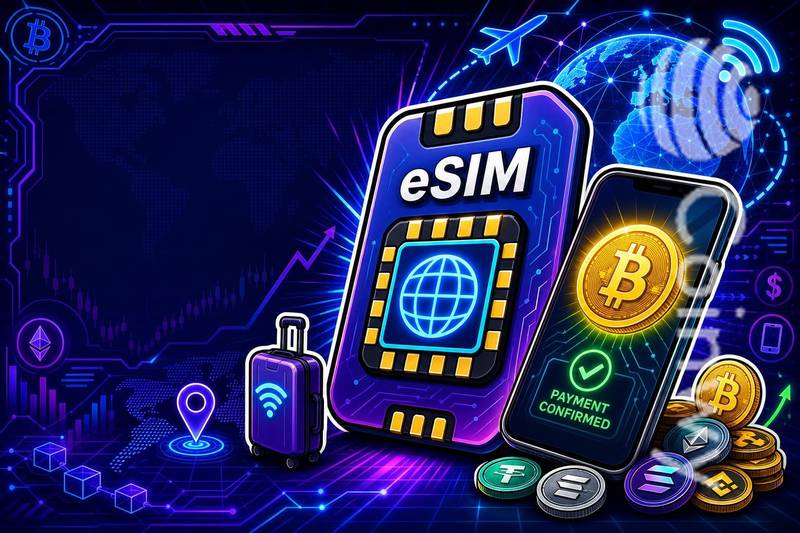
An eSIM lets travelers and privacy-conscious crypto holders buy mobile data plans online, pay with Bitcoin or other cryptocurrencies, and activate service instantly on a compatible device, all without swapping a physical SIM card.
The concept is straightforward: an eSIM is a digital SIM embedded in modern smartphones, tablets, and laptops. Instead of inserting a plastic card, users download a carrier profile over the internet. The GSMA, the global trade body for mobile operators, defines eSIM as a standardized way to remotely provision subscriber profiles onto devices. For related coverage, see Bitcoin Falls 2.1% Amid Broader Crypto Market Sell-Off.
A growing number of services now accept crypto for eSIM purchases. Bitrefill launched an eSIM service covering over 140 countries, letting users pay with Bitcoin, Lightning Network, Ethereum, and other digital assets. The appeal is clear: buyers who already hold crypto can skip currency conversion fees and complete checkout in seconds. For related coverage, see Trump UAE Crypto Deal Probe: Senate Democrats Push.
Why Crypto Payments Make Sense for eSIM Buyers
International travelers face a recurring problem. Arriving in a new country often means hunting for a local SIM vendor, dealing with ID requirements, or paying roaming fees. An eSIM purchased before departure solves this by activating data service remotely.
Paying with crypto adds another layer of convenience. Users avoid sharing credit card details with unfamiliar vendors. The transaction settles without a bank intermediary, which matters in regions where crypto tax and regulatory frameworks are still evolving.
Speed is a practical factor too. A Lightning Network payment confirms in seconds, meaning a traveler can buy a data plan and install it on the same device within minutes. For users already managing digital assets, this removes friction that traditional payment methods introduce.
How to Buy an eSIM Plan With Crypto Step by Step
Before purchasing, confirm your device supports eSIM. Most iPhones from the XS onward and many recent Android phones include eSIM capability. Check your device settings or manufacturer documentation.
Next, compare plans by destination coverage, data allowance, and validity period. Bitrefill’s eSIM catalog lists plans by country and region, showing data limits and active days. Some plans cover a single country; others span entire regions like Europe or Southeast Asia.
Once you select a plan, the checkout process typically follows these steps:
- Choose your cryptocurrency. Common options include Bitcoin, Lightning, Ethereum, USDT, and Litecoin. Verify the exact coins and networks the provider supports before sending funds.
- Confirm the payment amount and wallet address. Double-check the network (sending Bitcoin on the wrong network means lost funds). Copy the address carefully or scan the QR code provided.
- Wait for payment confirmation. On-chain Bitcoin transactions may take 10 to 60 minutes. Lightning payments confirm almost instantly.
- Receive your eSIM profile. After payment clears, the provider sends a QR code or manual configuration details via email or on-screen.
- Install and activate. Scan the QR code in your device’s cellular settings. Some plans activate immediately; others start counting data from the moment you first connect in the destination country.
What to Check Before You Pay
Crypto transactions are irreversible once confirmed on the blockchain. Unlike credit card purchases, there is no chargeback mechanism. This makes pre-purchase verification essential.
Start with the refund policy. Some providers offer refunds for uninstalled eSIMs; others do not. Know the terms before you send crypto. Similarly, check activation windows, as some plans expire a set number of days after purchase regardless of whether you used them.
Examine the plan details beyond headline data amounts. Throttling rules, hotspot support, and whether the plan includes voice or SMS vary widely. A 5GB plan that throttles after 1GB of high-speed data delivers a very different experience than one offering full-speed throughout.
Country coverage deserves scrutiny too. A “Europe” plan may not cover every European country. Confirm your specific destinations are listed. Providers with transparent coverage maps and clearly stated terms, like those following established digital infrastructure standards, tend to be more reliable.
Finally, evaluate support quality. If your eSIM fails to activate in a foreign airport, responsive customer support matters. Check whether the provider offers live chat, email support, or a help center with installation guides before you commit funds.
As crypto payment infrastructure continues to expand, the number of services accepting digital assets for everyday purchases like eSIM plans is likely to grow. For now, buyers who verify plan details, confirm payment parameters, and choose reputable providers can use crypto to stay connected across borders with minimal friction.
Disclaimer: This article is for informational purposes only and does not constitute financial or investment advice. Cryptocurrency and digital asset markets carry significant risk. Always do your own research before making decisions.
Read also :
- Bitcoin Miners Face Margin Squeeze as Revenue Drops Below Production Costs
- Binance Withdraws MiCA Application Filed in Greece
- Bitcoin ETP Outflows Push Rolling One-Year Flows Negative for First Time Since 2023, K33 Says
- Bybit Launches Dedicated AI Subaccounts in MENA
- Bitcoin Falls 2.1% Amid Broader Crypto Market Sell-Off