


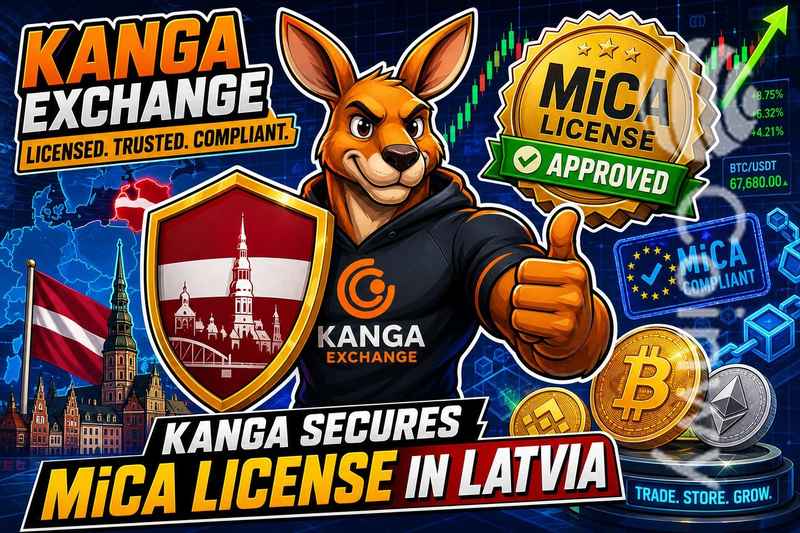
Polish cryptocurrency exchange Kanga has secured a MiCA-compliant license in Latvia, positioning itself among a growing number of crypto firms obtaining regulatory approval under the European Union’s Markets in Crypto-Assets framework.
Kanga’s MiCA License Marks a New Regulatory Milestone
Kanga, a crypto exchange headquartered in Poland, has obtained a license to provide crypto-asset services in Latvia. The Latvian central bank, Latvijas Banka, has been issuing licenses for crypto-asset service providers under the MiCA regulatory regime, which became the EU’s unified framework for digital asset regulation. For related coverage, see Buy eSIM Plans With Crypto: Complete Guide | CoinWy.
MiCA, or the Markets in Crypto-Assets Regulation, establishes a single licensing standard across all 27 EU member states. For Kanga, securing this license represents a shift from operating under Poland’s national registration system to holding a pan-European regulatory credential. For related coverage, see Bitcoin Falls 2.1% Amid Broader Crypto Market Sell-Off.
The development comes as crypto firms have been seeking licenses in various EU jurisdictions following regulatory shifts in their home markets. Poland’s own path toward MiCA implementation has been closely watched by industry participants.
Why Latvia Matters in Kanga’s EU Compliance Strategy
Kanga’s decision to pursue licensing in Latvia rather than its home market of Poland is notable. Under MiCA, a license obtained in any EU member state can potentially be passported across the bloc, giving the holder the ability to offer services in all member states.
Latvia has emerged as one of the jurisdictions actively processing crypto-asset service provider applications. Latvijas Banka’s licensing activity signals the country’s readiness to serve as a regulatory gateway for firms seeking MiCA-compliant status.
Poland has been navigating its own MiCA adoption timeline. The Polish government recently passed its MiCA crypto bill, but the legislative process has created a window during which Polish firms have looked to other EU jurisdictions for faster licensing paths.
For Kanga, which operates as a crypto exchange serving retail users, the Latvian license provides regulatory certainty while Poland’s domestic framework continues to take shape.
What Kanga’s Approval Signals for the European Crypto Sector
Kanga’s licensing is part of a broader pattern of exchanges seeking MiCA compliance ahead of full enforcement deadlines. Not all firms have navigated this process smoothly; Binance withdrew its MiCA application filed in Greece, highlighting the complexity of the licensing landscape across different EU jurisdictions.
The trend toward regulatory clarity in Europe stands in contrast to the fragmented approaches seen in other major markets. For smaller exchanges like Kanga, obtaining a MiCA license early could provide a competitive advantage in building user trust across the EU.
As more exchanges secure MiCA licenses across various member states, the framework’s practical impact on market structure and competition in Europe will become clearer. Kanga’s Latvian approval adds one more data point to that emerging picture.
Disclaimer: This article is for informational purposes only and does not constitute financial or investment advice. Cryptocurrency and digital asset markets carry significant risk. Always do your own research before making decisions.