



Last updated: November 17, 2026. Independent editorial review. We have no commercial relationship with Convex Finance.
Who This Guide Is For
This guide is for people who have heard that Convex "boosts" the yield on Curve, and have no idea what that means. You do not need to know what Curve is, what a gauge is, or why anyone would lock a token for four months. We explain each term the first time it appears, using everyday comparisons.
It is also for readers who already know Convex from the 2021 and 2022 "Curve Wars", and want to see what the product looks like in late 2026. The short version is that it is much smaller than it was at its peak, it has added support for two more protocols (Frax and f(x)), and its token has lost almost all of its former value. The site still works, and parts of it are still useful. Other parts are confusing, and we point those out.
We did not only read the marketing pages. We opened the live site on a desktop, a tablet and a phone, connected a throwaway wallet, clicked through every screen we could reach, and compared the numbers with independent sources. Where we could not test something, we say so.
How We Tested Convex
| Device | Viewport | What we did |
|---|---|---|
| Desktop | 1440 x 900 | Homepage, docs, Stake page, Claim, Lock CVX, Governance, Treasury, all pool tabs |
| Tablet | 1024 px wide | Homepage, Stake page and Lock CVX page |
| Phone | about 430 px wide | Homepage, Stake page and Lock CVX page |
The Wallet We Used
We used a brand new, throwaway MetaMask profile created only for testing. It held no tokens that mattered, and we did not deposit anything. We did not sign any transaction and we did not approve any token spending permission. The only approval we gave was the connection request that lets a site read the wallet address.
This matters for a protocol like Convex, because almost every action on it starts with an "Approve" button. We stopped at that button every time. We looked at what each form asks for, but we never pressed Approve, Convert, Stake, Lock or Claim. The full list of what we did not test is in the FAQ at the end.
Quick Verdict
Convex is a mature, audited and still functioning yield layer for Curve, with a clear fee table and a treasury page anyone can read. It is also a shrunken version of its former self. Its value locked is about 98 percent below the peak, its CVX token is about 98 percent below its all-time high, and its homepage shows a total value locked that is higher than the figure on the main independent tracker. Its history includes a 2022 website hijack, its admin multisig includes people from outside the team, and several audits are about three and a half to five years old. It is best seen as a specialist tool for people who already hold CRV or Curve liquidity tokens, not a place for a beginner to start.
| Item | Detail |
|---|---|
| Project | Convex Finance |
| Website | convexfinance.com (marketing pages) and curve.convexfinance.com (the app) |
| Chains | Ethereum, Arbitrum, Polygon, Fraxtal |
| Works with | Curve, Frax and f(x) Protocol |
| Tokens | CVX (governance) and cvxCRV (tokenized veCRV) |
| Our editorial score | 3.6 out of 5 (editorial judgment, not a weighted calculation) |
| Wallet needed to browse | No for the homepage and the Lock page, yes to see personal balances |
| Money at risk in our test | None |

What Is Convex (Plain English)
Start with Curve. Curve is a decentralized exchange that specializes in swapping tokens that should have a similar price, such as one dollar stablecoin for another. People who deposit their tokens into a Curve pool are called liquidity providers. In return they earn trading fees and a reward token called CRV.
Here is the twist. Curve lets you earn a bigger share of the CRV rewards if you lock up CRV for a long time (up to four years). The locked version is called veCRV, where "ve" stands for "vote escrowed". Locking also gives you voting power over which pools get the most rewards. The more veCRV you hold, the bigger the "boost" on your own deposits.
Locking CRV for four years is a big ask. Most people do not want to do it. Convex solves that with a pooling trick.
Think of a gym that sells a very cheap group membership, but only if you sign a four-year contract and buy in bulk. Nobody wants to sign alone, so a company signs one huge contract for everybody and lets each member use the gym at the discounted rate. The company takes a cut of what members earn. Convex is that company, and veCRV is the bulk contract.
In Plain Terms
- You deposit Curve liquidity tokens into Convex, and Convex deposits them on Curve using its own huge pile of locked veCRV.
- Because the pile is huge, your deposit gets a boosted reward rate that you could not get on your own.
- Convex keeps a share of the rewards as its fee and passes the rest on to you.
- If you hold CRV and do not need it back, you can convert it to cvxCRV. This is a one-way trip, and we explain why it matters below.
The Four Roles
| Role | What you do | What you get | Main risk |
|---|---|---|---|
| Curve LP staker | Deposit Curve pool tokens into Convex | Boosted CRV and CVX rewards plus the pool's trading fees | Pool risk on Curve and smart contract risk |
| cvxCRV holder | Convert CRV into cvxCRV and stake it | A share of platform fees and Curve fee income | cvxCRV can trade below CRV and the conversion is permanent |
| CVX staker | Stake CVX without locking | A share of platform fees paid as cvxCRV | CVX price risk |
| CVX locker (vlCVX) | Lock CVX for 16 weeks plus one day | Voting power and a share of fees and vote incentives | Funds stuck for months, price risk |
Key Facts
| Item | Figure | Source and date |
|---|---|---|
| Total value locked (homepage) | $549.8m to $549.9m | Convex homepage, Nov 17, 2026 |
| Total value locked (tracker) | $433.8M | DefiLlama, Nov 17, 2026 |
| Protocol page TVL | $435.2M | DefiLlama protocol page, Nov 17, 2026 |
| Peak TVL | $21.17B | DefiLlama, all-time high |
| Platform revenue (homepage) | $224.9m | Convex homepage, Nov 17, 2026 |
| Treasury | $14.6m | Convex homepage and Treasury page, Nov 17, 2026 |
| cvxCRV staked | 343.2m | Convex homepage, Nov 17, 2026 |
| Chains | Ethereum, Fraxtal, Arbitrum, Polygon | DefiLlama, Nov 17, 2026 |
| Audits listed | 2 | DefiLlama (the docs list more) |
| Hack history | One DNS hijack, June 2022, about $14k stolen and repaid | DefiLlama hacks database |
Why the Numbers Differ
The homepage says $549.8m. DefiLlama says $433.8M for Convex, and its own protocol page says $435.2M. That is a gap of about $116M. One partial explanation is that DefiLlama lists a separate "staking" figure of $72.1M. If you add it, you get $505.9M (our calculation), which is closer but still about $44M below the homepage. We could not find the reason for the rest of the gap, and we cannot say which number is "right". Different sites count different things, and some count the same token twice (for example, CVX that is locked and also counted as a reward). When you compare protocols, use one source for all of them.
The homepage figure also moved by $0.1m between our desktop capture ($549.8m) and our tablet capture ($549.9m), a few minutes apart. That is normal for a live number, but it reminds you that these are snapshots.
The Big Drop
Convex's value locked peaked at $21.17B, and now stands at $433.8M on DefiLlama. That is about 98 percent lower (our calculation). The cause is not a hack. Our reading is that the "Curve Wars" of 2021 and 2022 drew huge amounts of capital into Curve, and that yields and interest then faded. This is a story about a hot trend cooling, not a failure of the contracts.
Related Entries
Curve itself (the exchange Convex builds on) shows about $1.014B on DefiLlama. Convex is therefore less than half the size of the exchange it sits on top of. Other "yield layer" names are listed in the competitor section below.
How Convex Looks on Your Device
Desktop
On desktop, the homepage is a dark page with a pixel-art safe and a big "Boosted Staking" headline. The first screen gives you four numbers: total value locked, platform revenue, treasury and "14D emissions controlled", plus a box titled "Governance Power" showing how much of Curve's, Frax's and f(x)'s voting power Convex controls. On Nov 17, 2026 it listed 423.1m veCRV (54.63 percent of the total), 27.7m veFXS (54.09 percent), 164.2k veFXN (32.58 percent) and 6.4m RSUP (20.19 percent).
That last box is the real story of Convex. A single project controls more than half of the voting power on Curve and on Frax. We come back to that in the risk section.
The app itself lives on a different address, curve.convexfinance.com. The top bar has Stake, Claim, Lock CVX and a "More" menu, and a switcher to flip between Curve, Frax and f(x).

Tablet
On a tablet the homepage keeps the two-column layout and the app keeps its full top bar. We saw no clipped text. Our tablet Stake capture shows the whole page working, with the pool table readable and the tabs in one row.


Phone
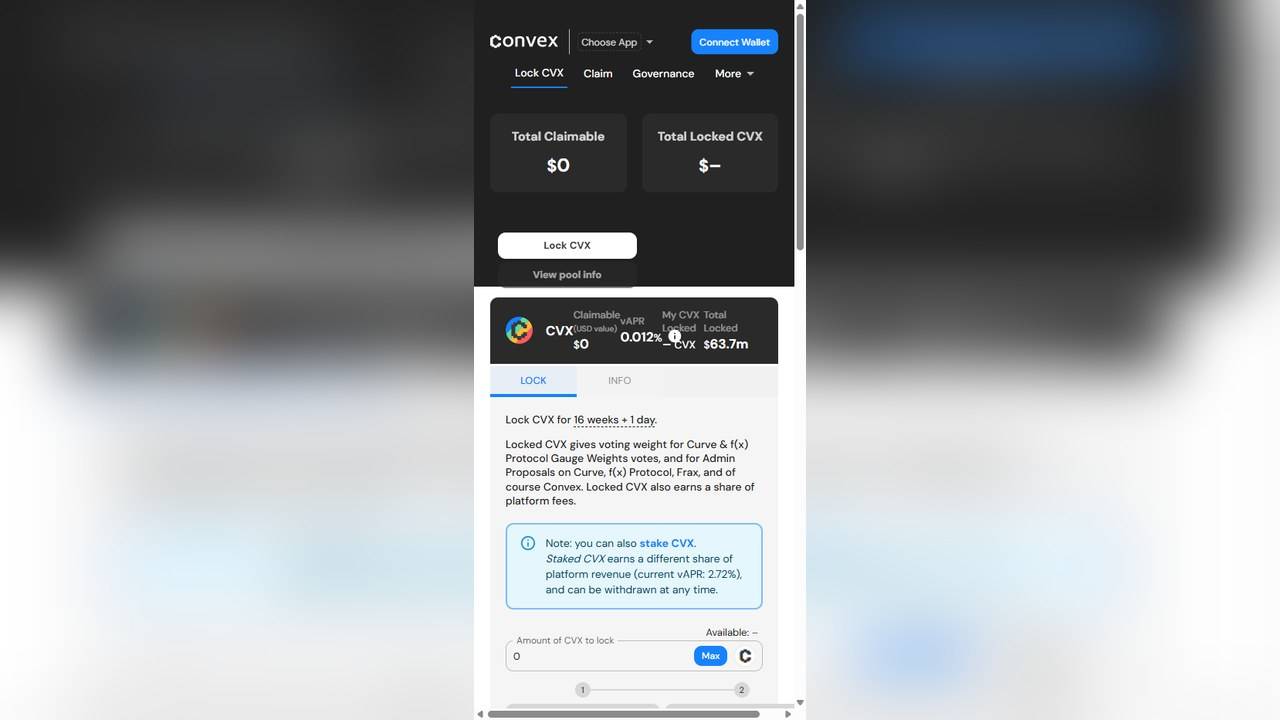
On a phone the layout stacks into a single column. The stats become small tiles and the "Governance Power" box sits under them. It is readable. The Stake page is where the phone layout slips: the header numbers "Claimable", "My vAPR" and "Max vAPR" are squeezed into a row and the labels run into each other, so "My vAPR" and "Max vAPR" appear as one smudged line. The Convert / Stake tabs are also cut off at the right edge, so the "Unstake" and "Info" tabs are hidden until you scroll sideways. A horizontal scroll bar appears at the bottom of the page.


Bugs and Rough Edges We Found
- On a phone, the Stake header labels overlap and the tab row is cut off.
- Several URLs that you might guess return a "404 This page could not be found" message. We tried
/poolson the main site, and/governanceand/stake-cvxon the www address. The working addresses are different (the app is oncurve.convexfinance.comand governance is at/vote). A first-time visitor who types a guess will hit a dead end. - The homepage menu says "Governance", but the apps menu and the main menu are not the same on every page. The Lock page shows "Choose App" and "Governance" in its top bar, while the Stake page shows "Curve", "Stake", "Claim" and "More".
Connecting Your Wallet
- Go to the Convex app (curve.convexfinance.com). Check the address bar carefully, which we explain in the security section.
- Click the blue Connect Wallet button in the top right.
- Pick your wallet from the list. We picked MetaMask.
- Your wallet pops up and asks whether you allow the site to see your address. Click Connect. This is only a "show me your address" request. It does not move funds.
- The top bar now shows the network you are on, a small gas price figure and a shortened version of your address.
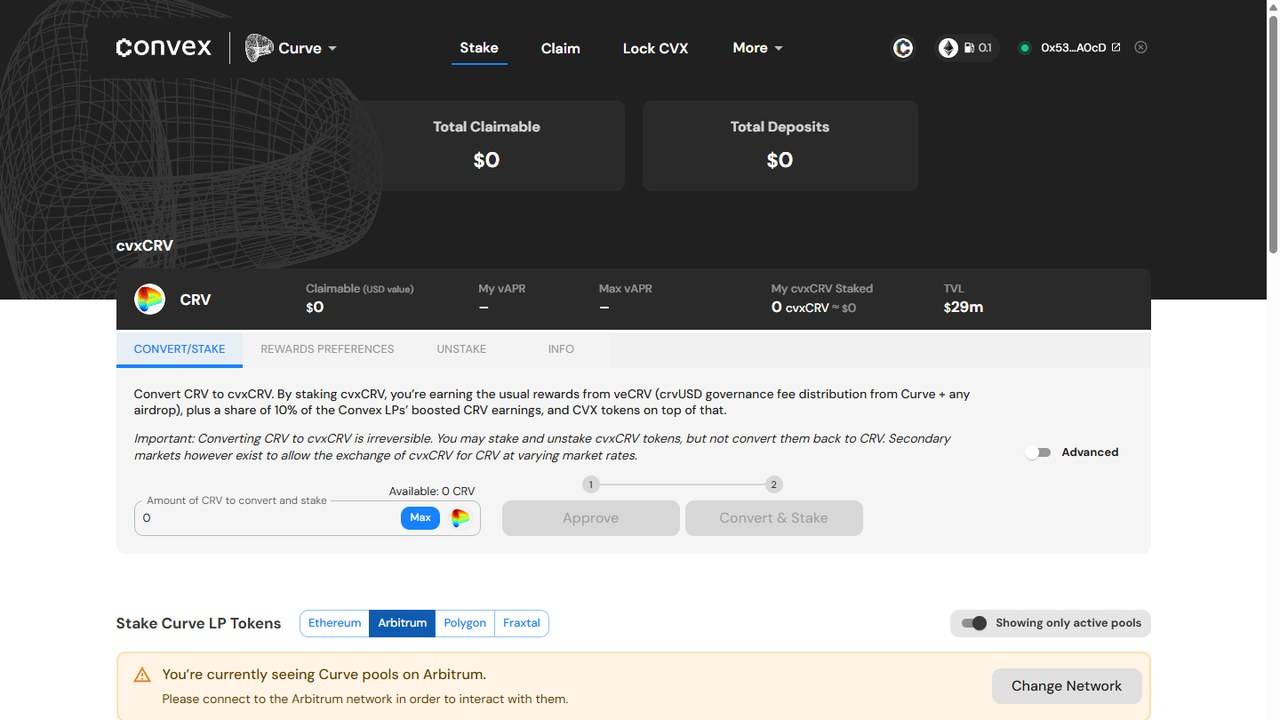
After connecting, the page we saw showed "Total Claimable $0" and "Total Deposits $0", which is correct for an empty wallet. It also showed a panel for cvxCRV with a "TVL $29m" figure.
Beginner safety tip: A standard address-connection request does not itself authorize token transfers, but verify the site and wallet prompt. An approval gives a contract permission to move a specific token from your wallet, sometimes without a limit. Read the popup before you accept, and prefer setting an exact amount rather than "unlimited".
Core Features at a Glance
| Feature | What it does | Tested by us |
|---|---|---|
| Convert and stake cvxCRV | Turns CRV into cvxCRV, then stakes it for rewards | Viewed forms, did not press any button |
| Reward preferences | Lets you choose how your rewards are split | Viewed and moved nothing |
| Stake Curve LP tokens | Deposit Curve pool tokens for boosted rewards | Viewed pool list and one pool page |
| Other chains | Pool lists for Arbitrum, Polygon and Fraxtal | Viewed tabs, did not switch network |
| Claim | One page to collect rewards | Viewed, nothing to claim |
| Lock CVX (vlCVX) | Lock CVX 16 weeks for votes and fees | Viewed form and info tab |
| Stake CVX | Flexible alternative to locking | Viewed panel |
| Governance | Gauge weight votes and DAO proposals | Viewed |
| Treasury | Public page of what the treasury holds | Viewed |
| Frax and f(x) apps | Same idea for other protocols | Saw the app switcher only |
Feature 1: Convert and Stake cvxCRV
This is the first panel on the Stake page. It has four tabs: Convert/Stake, Rewards Preferences, Unstake and Info.
The text on the panel is direct about the trade-off. In our own words, converting CRV into cvxCRV is irreversible. You can stake and unstake cvxCRV, but you cannot turn it back into CRV on the site. A secondary market exists where you can swap cvxCRV for CRV at whatever the market price is. The price is the catch: CoinGecko showed cvxCRV at $0.0845 on Nov 17, 2026, and we explain in the token section how thin the trading is.
Why would anyone do this? CRV locked forever gives voting rights and a share of Curve's fee income, and Convex wraps that into a token you can hold. Staked cvxCRV earns CRV, CVX and crvUSD, according to the docs.
The default form is a single box: type an amount of CRV, then press Approve and Convert & Stake. If you flip the Advanced switch, the form splits into three: convert and stake together, convert only, or stake only.

Rewards Preferences
This tab has a slider that lets you decide what you are paid in. At one end you receive more governance tokens (CRV and CVX), and at the other you receive more of a stablecoin (crvUSD). The header shows the maximum vAPR for each extreme: 11.89 percent if you take 100 percent crvUSD, and 20.23 percent if you take 100 percent CRV and CVX.
"vAPR" means variable annual percentage rate. It is a forecast based on recent rewards, not a promise. Notice that the higher number is paid in volatile tokens. If CRV and CVX fall in price, that 20.23 percent can be worth much less in dollars.

Unstake and Info
The Unstake tab is simple: choose an amount and press Unstake. A line on it says that unstaked cvxCRV does not earn anything, because all rewards accrue only to staked cvxCRV. That is a useful reminder. If you unstake and forget, you earn zero.

The Info tab lists the contract addresses used by the panel. These are public protocol addresses. We keep them out of this article, and suggest you copy addresses only from the official docs.
Feature 2: Stake Curve LP Tokens
Under the cvxCRV panel is a table titled "Stake Curve LP Tokens". It has network buttons (Ethereum, Arbitrum, Polygon, Fraxtal), a search box and filter chips: My Pools, All, Stable, Crypto, crvUSD and Convex. A switch labelled "Showing only active pools" is on by default.
Each row shows a pool name, claimable rewards, vAPR, your deposits and the pool's TVL. Clicking a row opens a deposit panel.


A Warning Example From the Live Page
When we opened the table on Nov 17, 2026, the first row was a pool called yUSD+USDC with a vAPR of "500+%". Right next to it was a TVL of $128.77. That is not a typo: the pool held about the price of a nice dinner. A giant percentage on a tiny pool means very little money is earning the rewards, so each dollar gets a huge share. It does not mean you can earn 500 percent. Add your own money and the percentage would likely drop sharply, and a pool this small may be hard to exit without moving the price.
The next rows showed 33.13 percent on $150.8k (YB+yYB), 32.49 percent on $275.6k and 27.36 percent on $204.8k. All of these are small pools. Treat the vAPR column as a list of where rewards are concentrated, not as a guide to what is safe.
Other Chains
The Arbitrum and Fraxtal buttons switch the list to pools on those networks. A yellow banner says "You're currently seeing Curve pools on Arbitrum" and asks you to change network in your wallet before you can interact. We did not change network. We only viewed the lists.

Feature 3: Claim
The Claim page is a single place to collect what you have earned. On our page it had sections for Curve pools, Curve lending, staked cvxCRV, staked CVX and locked CVX, and a notice saying that locked CVX claims have moved. We did not follow that notice, so we cannot say where they moved to. Our balance was empty, so no claim buttons were active.

A tip for real users: claiming costs a network fee each time. If you hold small amounts, claim rarely.
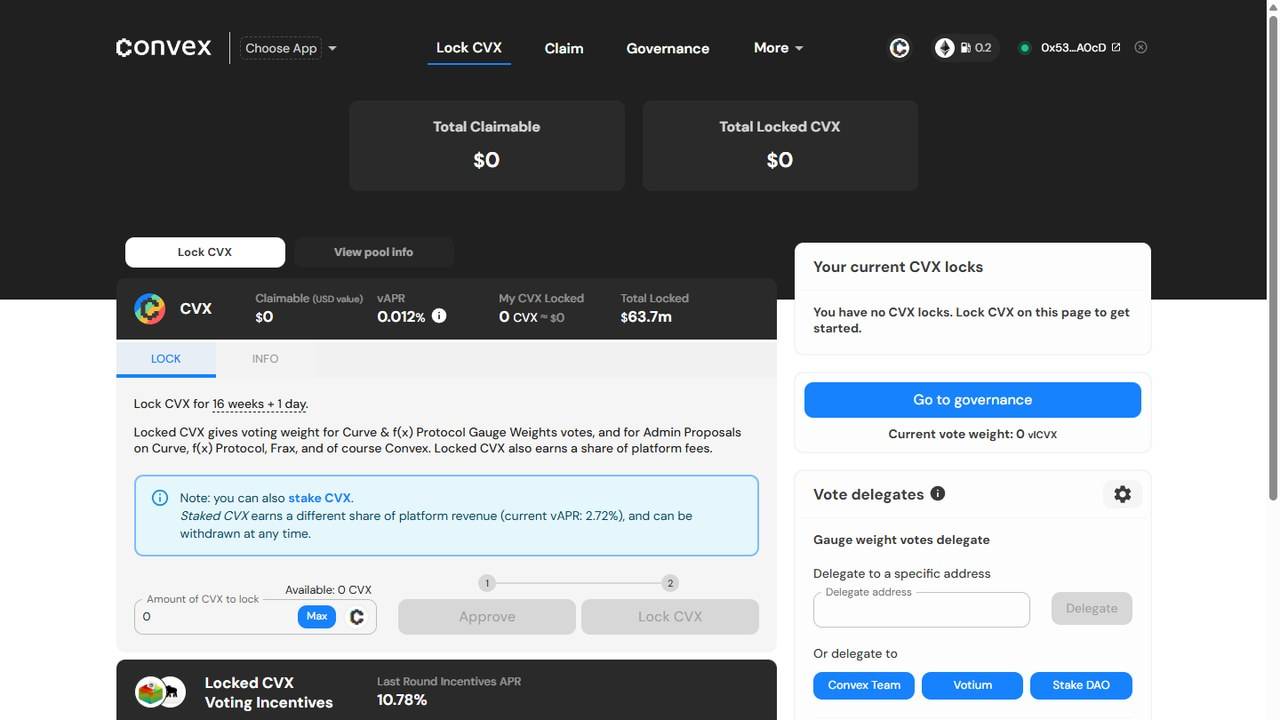
Feature 4: Lock CVX (vlCVX)
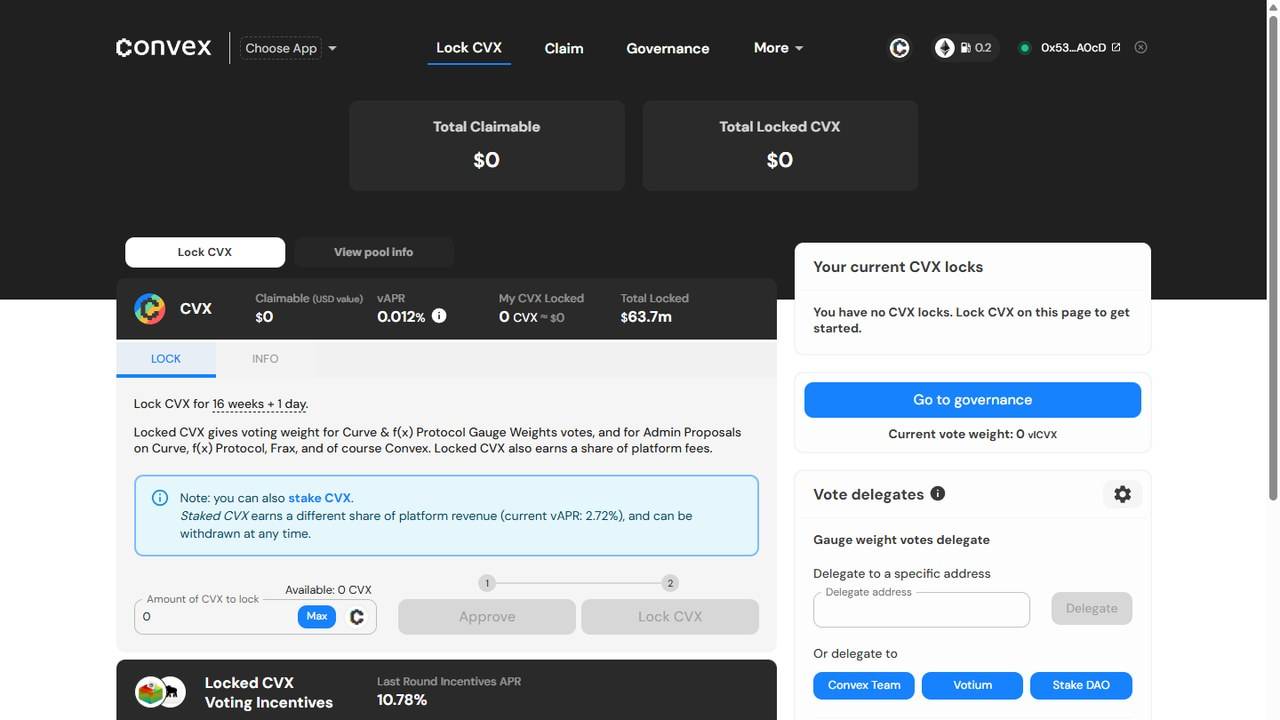
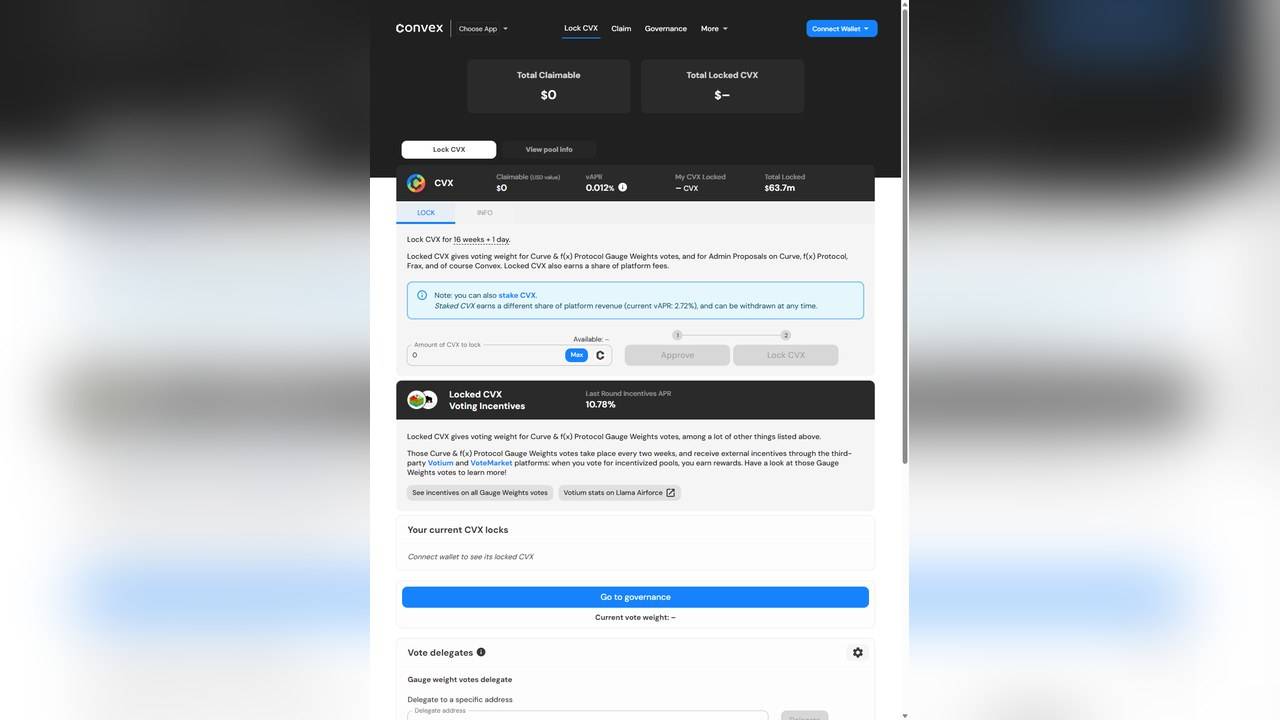
Locking CVX is the other half of Convex. When you lock CVX you receive "vlCVX", which means vote-locked CVX. According to the docs, the lock is a minimum of 16 weeks. The page says "16 weeks + 1 day".
What do you get for it? The page says locked CVX gives you voting weight on Curve and f(x) gauge weights and on proposals across Curve, f(x), Frax and Convex, plus a share of platform fees.
How the timing works, according to the docs:
- Locks are grouped into weekly epochs that start on Thursday at 00:00 UTC.
- Tokens locked in the current epoch do not count toward a vote that is already running.
- If you lock just before a new epoch, you wait about 16 weeks. If you lock in the middle of one, you wait 16 weeks plus the rest of that week.
- After 16 full epochs your CVX unlocks automatically, but it then sits idle in the locker contract. If it sits idle more than four epochs, anyone can "kick" it out and keep a 0.25 percent bounty per epoch. The docs give the example of 400 CVX idle for five weeks, where the caller gets 1 CVX.
That last rule is easy to miss. If you forget your lock, you can lose a small slice.
The Numbers on the Lock Page
| Figure on page | Value | Meaning |
|---|---|---|
| vAPR | 0.012% | Return from platform fees alone |
| Total locked | $63.7m | USD value of all locked CVX |
| Last round incentives APR | 10.78% | Return from vote incentives paid by third parties |
The 0.012 percent is not a typo, it is the fee share. The real return comes from the second figure. Every two weeks, Curve and f(x) holders vote on which pools get the most reward tokens. Other projects pay vlCVX holders (through platforms the page names as Votium and VoteMarket) to vote for their pools. Those payments are often called bribes. They are legal and openly run, and that is the whole business model of the "Curve Wars". The governance page showed a similar but not identical figure of 10.56 percent, so the number moves between views.
Our calculation: $63.7m divided by the CVX price of $1.41 is about 45.2 million CVX, which matches the 45.3m vlCVX figure on the governance page. That is about 49 percent of the 93.19M circulating supply, so a large part of CVX is locked.

Pool Info and Vote Delegates
The "View pool info" button opens a table of pools with the TVL, the current veCRV allocation and "Boosted Share of Curve Pool". Many Frax pool rows had tiny TVL (for example $86.62 and $103.08) and a boosted share of 100 percent. Again, a large share of a tiny pool.
On the right, the "Vote delegates" box lets you hand your voting power to another address. There are one-click shortcuts for Convex Team, Votium and Stake DAO, and a box for any specific address. This is helpful if you do not want to vote every two weeks, but delegating means someone else decides your gauge votes, so pick carefully. We pressed nothing.

Feature 5: Stake CVX
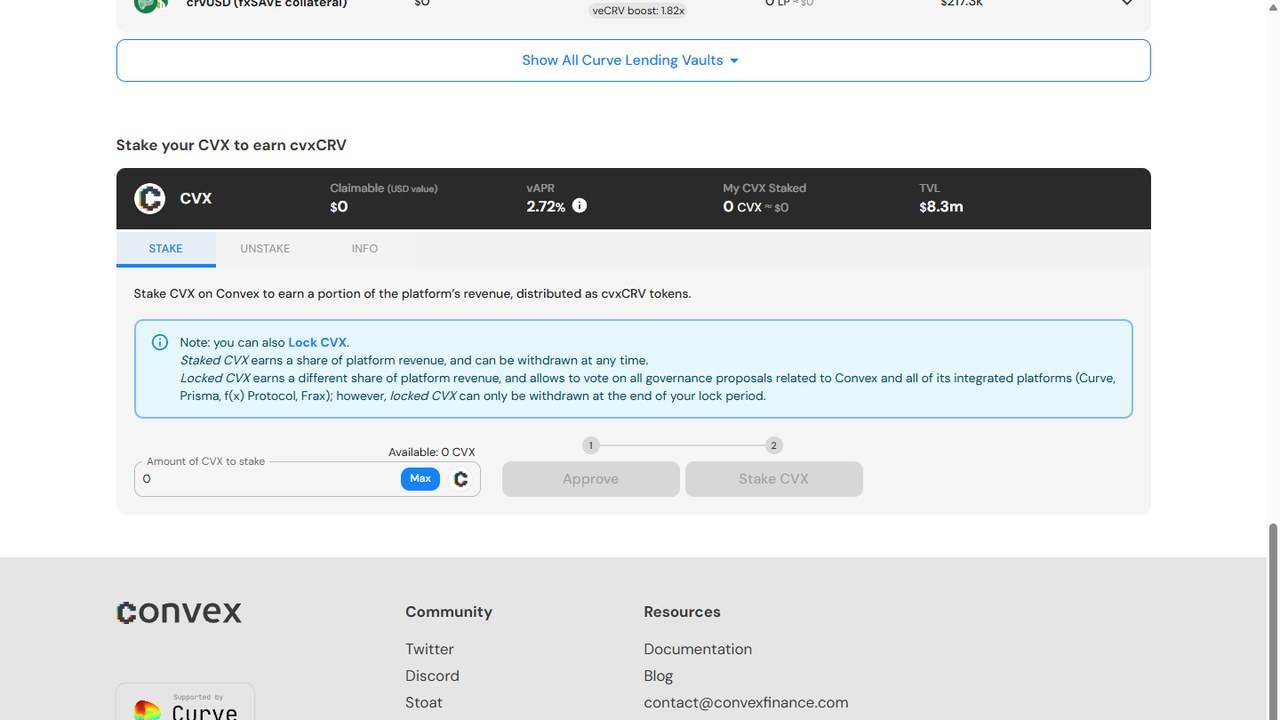
There is a lighter option than locking. Staking CVX has no lock period, and the page says you can withdraw at any time. It earns a different share of platform revenue. On Nov 17, 2026 the page showed a vAPR of 2.72 percent and TVL of $8.3m.
The trade-off is plain: staked CVX is liquid but pays less than the lock's vote-incentive route, and does not give voting weight.
Feature 6: Governance
The Governance page, reached at /vote on the app, shows gauge weights for Curve and f(x) and a list of DAO proposals. It also shows statistics such as the total vlCVX of 45.3m. A DAO is a group of token holders who vote on changes. We opened the page and read it. We did not vote, because we held no vlCVX.
One clarification matters. Because Convex holds so much veCRV, the votes of vlCVX holders effectively steer a large share of Curve's reward flow. That is real influence, and it is also a concentration to be aware of.

Feature 7: Treasury
The Treasury page is one of the better parts of the site. It splits the holdings into a Vault of $13.1m and Managers of $1.6m, for a total of $14.6m on Nov 17, 2026. The assets listed included about 8.4m CVX (worth about $11.8m by our calculation at $1.41), plus sfrxETH, stkCvxCRV, wstETH, FXN, CRV, FXS and some liquidity positions.
Our calculation: CVX is about 81 percent of the treasury by value. That means the treasury is mostly a bet on Convex's own token. If CVX falls another 30 percent, the treasury shrinks accordingly. The docs say the treasury is controlled by the multisig, at the discretion of the Convex team.

Feature 8: Frax and f(x) Apps
The "Curve" switcher in the top bar opens a list with Curve, Frax and f(x). Convex does for Frax's veFXS and f(x)'s veFXN what it does for Curve, and it has also supported vePrisma. The docs list cvxFXS, cvxFXN and cvxPrisma tokens, and list cvxFPIS as sunset. We only viewed the switcher and did not open the Frax or f(x) apps, so we have nothing to say about how they work on screen.

Feature 9: Documentation
The docs site (docs.convexfinance.com) is a GitBook with sections for each protocol, tokenomics, governance, how-to guides, FAQ pages for fees, risks, audits, the treasury and multisig rights. It is organized well. The footer of the welcome page says "Last updated 2 years ago", which is a sign that the docs are not kept as fresh as the app.

The CVX and cvxCRV Tokens
CVX Market Data
| Item | CVX | Source and date |
|---|---|---|
| Price | $1.41 | CoinGecko, Nov 17, 2026 |
| Market cap | $131.03M | CoinGecko, Nov 17, 2026 |
| Fully diluted value | $140.6M | CoinGecko, Nov 17, 2026 |
| 24-hour volume | $4.12M | CoinGecko, Nov 17, 2026 |
| Circulating supply | 93.19M | CoinGecko, Nov 17, 2026 |
| Max supply | 100M | CoinGecko and docs |
| All-time high | $60.09 (down 97.66%) | CoinGecko |
| 7-day change | down 20.7% | CoinGecko, Nov 17, 2026 |
| 30-day change | down 26.8% | CoinGecko, Nov 17, 2026 |
| Rank | 205 | CoinGecko, Nov 17, 2026 |
cvxCRV Market Data
| Item | cvxCRV | Source and date |
|---|---|---|
| Price | $0.0845 | CoinGecko, Nov 17, 2026 |
| Fully diluted value | $35.97M | CoinGecko, Nov 17, 2026 |
| Market cap | Not reported | CoinGecko |
| 24-hour volume | $17.6k | CoinGecko, Nov 17, 2026 |
| Total supply | 425.6M | CoinGecko |
| All-time high | $6.16 (down 98.6%) | CoinGecko |
| 7-day change | down 20.3% | CoinGecko, Nov 17, 2026 |
| 30-day change | down 37.6% | CoinGecko, Nov 17, 2026 |
Why the Numbers Differ
CoinGecko does not report a market cap for cvxCRV, only a fully diluted value. We checked that its fully diluted figure is consistent with price times total supply (425.6M x $0.0845 is about $35.96M, our calculation). The homepage says 343.2m cvxCRV is staked, which at that price is about $29.0M (our calculation) and matches the "TVL $29m" on the Stake page. So the three numbers fit together, and the share staked is about 81 percent of total supply (our calculation).
How to Read This
- CVX has lost nearly all of its peak value. A $60 token that is now $1.41 has had a very long bear market, and it keeps falling: down about 27 percent in 30 days.
- CVX daily volume is about 3 percent of its market cap (our calculation), which is fine for a small token but not deep.
- cvxCRV trades only about $17.6k a day. That is tiny. If you convert CRV into cvxCRV and later want out, you rely on a very thin market, and a big sale would move the price. This is the practical meaning of "irreversible".
- Both tokens fell together in the last week, so staking one for the other does not protect you.
Token Distribution (Docs)
The docs describe a 100 million maximum supply for CVX:
| Share | Group | Terms in the docs |
|---|---|---|
| 50% | Curve LP rewards | Earned in proportion to CRV claimed on Convex |
| 25% | Liquidity mining | Distributed over 4 years |
| 10% | Convex team | Vested over 1 year |
| 9.7% | Treasury | Vested over 1 year |
| 3.3% | Investors | Vested over 1 year, with funds used to pre-seed the boost |
| 1% | veCRV holders | Instant airdrop |
| 1% | veCRV holders who voted to whitelist Convex | Instant airdrop |
These add up to 100 percent. The team and investors together hold 13.3 percent (our calculation), which is modest compared with many tokens. The vesting dates were in 2021, so the docs' vesting terms should be finished by now, but the docs do not show current holdings, and we did not check who holds what today. The docs also say the CVX minted per CRV reduces for every 100k CVX created.
Governance
CVX holders who lock their tokens vote on Convex proposals and on how Convex's veCRV is used on Curve, Frax and f(x). The home page quotes control of 54.63 percent of veCRV and 54.09 percent of veFXS.
Our reading: this is why third parties pay vote incentives. It also means that decisions about where a large share of Curve rewards flow are in the hands of a smaller group of vlCVX holders and the delegates they choose. If most vlCVX is delegated to a few names (the page offers the Convex Team, Votium and Stake DAO as shortcuts), power concentrates further. We did not look up the live delegation split, so we cannot give numbers.
Fees and Costs
According to the docs, the fee on Curve rewards is 17 percent of CRV revenue:
| Share | Goes to |
|---|---|
| 10% | cvxCRV stakers, paid in CRV |
| 4.5% | CVX stakers, paid in cvxCRV |
| 2% | Treasury |
| 0.5% | The caller who harvests the rewards |
The docs add that fees are taken only from CRV revenue, not from other incentive tokens or from veCRV admin fees. On Frax, the docs say the total is 20 percent of FXS revenue, split 10 percent to cvxFXS liquidity providers, 5 percent to vlCVX holders and 5 percent to the treasury. On f(x), the docs say 75 percent of revenue goes to cvxFXN stakers.
The multisig can change the Curve fee within hard limits written into the contracts: 10 to 15 percent for cvxCRV stakers, 3 to 6 percent for CVX stakers, 0 to 2 percent for the treasury and 0.1 to 1.0 percent for the caller, with an absolute ceiling of 20 percent. So the fee can rise, but only to a stated cap.
| Cost | What we saw |
|---|---|
| Deposit fee | None stated in the docs we read |
| Platform fee | 17% of CRV revenue on Curve (docs) |
| Withdrawal fee | None stated in the docs we read |
| Network gas | Paid on every approve, deposit, claim and lock |
| Hidden cost | cvxCRV exit price, and CVX lock-up time |
The top bar showed a small gas figure (0.1 to 0.2, unit not labelled) next to the network icon. Gas on Ethereum can be a real cost for small positions, because a deposit usually needs two transactions (approve, then deposit).
Security
What the Docs Say
| Area | What the docs say | Our note |
|---|---|---|
| Admin multisig | 3 of 5 Gnosis Safe on Ethereum and Arbitrum | Two members are Convex, three are outsiders (Llama Airforce, Votium, Frax Finance) |
| Admin power | Can change fees within hard-coded ranges, update the pool manager and stash factory, vote with the treasury and pause new deposits | Docs say it has no direct access to user deposits |
| Pause | Shutting down deposits still lets users withdraw | Docs claim, we did not test |
| Time locks | Docs say none are needed because admin controls cannot touch user funds | You have to trust that statement |
| Known issue | One known path through fake gauges and fake pools that abuses the shutdown system | Docs say it is believed sufficiently mitigated |
A 3 of 5 multisig means three of five named people must agree to make a change. The mix of two Convex members and three partners is better than a single team, but it also means a few outside organizations hold keys for a protocol that holds hundreds of millions of dollars.
Audits
The docs list these reports:
- MixBytes, April 2021 (the main platform audit)
- Peckshield, April 2022 (Frax), September 2022 (wrapper) and November 2022 (sidechain)
- Nomoi, January 2023 (wrapper and sidechain)
- ChainSecurity, April 2023 (wrapper)
DefiLlama counts two audits. The two lists do not match, and we did not read the reports, so we do not summarize their findings. The newest report we found is from April 2023. That is more than three years before this review, and the product has since added f(x) and other pieces. We could not confirm audits of the newer parts from the docs we read.
Bug Bounty
The docs include a payout table that depends on how likely and how severe a bug is:
| Likelihood | Low | Medium | High |
|---|---|---|---|
| Almost certain | $10,000 | $50,000 | $250,000 |
| Possible | $1,000 | $10,000 | $50,000 |
| Unlikely | $1,000 | $1,000 | $10,000 |
Bugs that only affect the front end, and already known issues, are excluded. The docs say reports must show a loss of funds or broken liveliness, and that AI agents must label their submissions. For a protocol holding hundreds of millions of dollars, a top payout of $250,000 is on the modest side. We did not test the submission process.
Track Record
DefiLlama's hacks database lists one entry for Convex, dated June 23, 2022. It was not a contract exploit. An attacker tricked a support agent at the domain provider NameCheap and redirected www.convexfinance.com to a copy of the site. At least 40 wallets approved transactions on the fake site. About $14k was stolen. DefiLlama classes it as Frontend and Infrastructure, and says Convex repaid all affected users from its treasury.
The lesson for you is practical. The contracts were not the weak point. The address people typed was. Always reach the app through a bookmark that you saved yourself, and never from a search ad or a message. This is also why we recommend you read each wallet popup carefully, even on a site you trust.
Risk Table
| Risk | Level in our view | Why |
|---|---|---|
| Smart contract bug | Medium | Several audits, but the latest is from 2023 and Convex also depends on Curve and Frax contracts |
| Website or DNS attack | Medium | It has happened once, in 2022 |
| Admin keys | Medium | 3 of 5 multisig including outside parties |
| Token price | High | CVX and cvxCRV are down more than 97 percent from their highs |
| Thin market | High for cvxCRV | About $17.6k daily volume |
| Dependence on Curve | High | The docs say users carry Curve and Frax risks as well |
| Lock-up | Medium | 16 weeks plus up to a week for vlCVX |
Convex vs Competitors
We list the larger yield-layer products in the same category on DefiLlama, with the figures from Nov 17, 2026. Curve is included as a reference point, since it is the exchange that Convex builds on, not a rival.
| Protocol | TVL (DefiLlama) | Note |
|---|---|---|
| Curve DEX | $1.014B | The exchange Convex builds on |
| Convex Finance | $433.8M | Boosts Curve, Frax and f(x) |
| Yearn | $132.5M | Automated vaults across many strategies |
| Beefy | $84.7M | Multi-chain auto-compounder |
| Concentrator | $53.9M | Built around Convex positions |
| Balancer V2 | $14.0M | Reference exchange for Aura |
| Aura | $7.9M | The Convex-style booster for Balancer |
Convex is the largest booster in this list by a wide margin, and it is roughly three times the size of Yearn. That is a notable position given the shrinkage since 2022. What it does not have is growth: the whole category has cooled, and the numbers above look small next to the old peak.
If your interest is broader than Curve, other guides in this series cover lending and staking from a different angle. Compare Compound, Euler and Spark for lending, Maple for institutional credit, Rocket Pool for Ethereum staking, Marinade for Solana staking, Orca for a Solana exchange, and Babylon and Symbiotic for restaking.
Pros and Cons
What We Liked
- Clear fee table. A stated 17 percent on Curve CRV revenue, with the changeable ranges and a hard ceiling published in the docs.
- Public treasury page. It shows what the project holds, in plain categories.
- Honest warning on cvxCRV. The app says in italics that conversion is irreversible.
- Fund-safety design on paper. The docs say the admin multisig has no direct access to user deposits, and that a pause still lets users withdraw.
- Flexible CVX options. You can lock for votes or stake with no lock.
- Layout works on all three devices. The homepage and the Lock page held up on tablet and phone.
- Free to browse. The homepage and the Lock page open without a wallet.
What We Did Not Like
- TVL mismatch. The homepage figure is about $116M higher than DefiLlama's.
- Huge vAPR on tiny pools. A 500+ percent figure on a $128.77 pool is easy to misread.
- Dead links. Several natural URLs return a 404.
- Phone Stake page. Header labels collide and the tabs are clipped.
- Old audits. The newest report we found is from April 2023.
- 2022 DNS hijack. Resolved, but it shows the front end is a real weak point.
- Thin cvxCRV market. About $17.6k of daily volume.
- Collapsed token. CVX is down about 98 percent from its high and fell another 27 percent in 30 days.
- Stale docs. The welcome page says it was last updated two years ago.
Who Should Use Convex
- Existing Curve liquidity providers. If you already provide liquidity on Curve, Convex is the usual way to add a boost without locking CRV yourself.
- Long-term CRV holders. If you hold CRV and will never need it back, cvxCRV staking is designed for you. Read the exit-price warning first.
- Governance-minded CVX holders. People who want to lock CVX and take part in vote incentives.
- People who read contracts and popups. The product asks for several approvals, so it rewards care.
Who should probably skip it: complete beginners who just want a simple return, anyone who may need their money back within a few months, and anyone who cannot accept that the token could fall further.
Verdict
Our editorial score is 3.6 out of 5. It is an editorial judgment, not a weighted calculation: it reflects the strengths and weaknesses discussed in this review, including interface, fees and treasury transparency, audits and security history, token performance, and cvxCRV liquidity.
Convex still does what it set out to do. The pages load, the numbers are readable, the fee table is clear and the treasury is public. The score is held down by things outside the interface: a token that has lost nearly all of its peak value, a shrunken base of users, audit reports that are about three and a half to five years old, a thin market for cvxCRV, and a 2022 incident that showed how a website can be hijacked. We would not call it unsafe. We would call it a specialist tool whose size and token price are far from their best days, and which you should only use with money you can afford to lock and risk.
FAQ
Is Convex Finance safe?
It is a long-running protocol with several audits, a public multisig and a small hack history (a 2022 DNS hijack that cost users about $14k and was repaid). It is not risk-free. You also carry Curve and Frax risks, and the latest audit we found is from April 2023.
Is Convex Finance legit?
Yes, it is a real, operating protocol and it appears on the main trackers with hundreds of millions of dollars locked. That does not make any deposit safe. Always check you are on the right address.
What does Convex Finance do in simple terms?
It pools many people's locked Curve voting tokens so that ordinary users can earn boosted rewards on Curve deposits, and it takes a fee for doing so.
What is cvxCRV?
It is a token you receive 1 to 1 when you give Convex your CRV. The CRV is locked forever. You cannot convert cvxCRV back to CRV on the site, only sell it on a market.
What is vlCVX?
CVX locked for 16 weeks plus up to one more week. It gives voting power and a share of fees and vote incentives.
What is the difference between locking and staking CVX?
Locking is for 16 weeks or more and gives voting power. Staking has no lock period but earns a different, lower share of fees. On Nov 17, 2026 the app showed a vAPR of 2.72 percent for staked CVX.
Why is the vAPR on some pools over 500 percent?
Because the pool is tiny. A very small pool shares the same rewards among very little money. It is not a realistic return.
Why does Convex show more TVL than DefiLlama?
We do not know. The homepage showed $549.8m and DefiLlama showed $433.8M. Different counting methods are the usual cause.
Can I lose money on Convex?
Yes. Pool tokens, CVX and cvxCRV can all fall in price, contracts can have bugs and you can lose money to fake websites or bad approvals.
Is CVX a good investment?
We do not give investment advice. We can only say that it trades about 98 percent below its all-time high and that its 30-day change was down 26.8 percent when we checked.
Do I need a wallet to look around?
No for the homepage and the Lock page. You need one to see personal balances and to use any form.
What did you not test?
We did not deposit, convert, stake, lock, unstake, claim or vote, and we did not sign any transaction. We did not change network to Arbitrum, Polygon or Fraxtal. We did not open the Frax or f(x) apps beyond the switcher. We did not test the bug bounty, the vote delegates, or the withdrawal of any funds. We did not read the audit reports. Everything about those actions comes from the docs or from what the page showed.
Quick Links
- Convex homepage
- Convex app (Curve)
- Convex documentation
- Convex fees page
- Convex audits page
- Convex on DefiLlama
- CVX on CoinGecko
- cvxCRV on CoinGecko
Disclaimer
This article is an independent editorial review for information only. It is not financial, legal or tax advice. Crypto assets are volatile and you can lose some or all of your money. We tested with a wallet that held no funds that mattered, and we did not sign any transaction. Figures are from the sources and dates named in each table and may have changed since. Do your own research before you stake, deposit, convert or lock.