





Perpetual futures are derivative contracts that track an underlying market without giving the trader ownership of the asset and without expiring on a fixed date. A trader opens a long to gain when the contract price rises or a short to gain when it falls, while margin supports the position and profit or loss changes with the contract price.
The missing expiry date creates the product’s defining mechanism: funding. Periodic payments between long and short positions help pull the perpetual price toward a spot-based index. The contract can remain open while margin is sufficient, but funding, fees, price impact and liquidation risk continue for as long as the position remains active.
What defines a perpetual futures contract?
A perpetual is closer to a continuously traded futures position than to a spot purchase. The trader deposits eligible collateral, selects a contract, chooses direction and size, and opens a position against another market participant or a protocol liquidity model. The platform records exposure and unrealized PnL rather than transferring the underlying coin into the trader’s wallet.
| Contract component | What it controls | What the trader sees |
|---|---|---|
| Underlying index | Reference value for the asset | Index price |
| Perpetual market | Price at which the derivative trades | Bid, ask, last price and order book |
| Mark price | Fair-value input used by the risk engine | Unrealized PnL and liquidation reference |
| Funding | Recurring transfer between longs and shorts | Rate, countdown and funding payment |
| Margin | Collateral supporting the position | Initial margin, maintenance margin and available balance |
| Settlement asset | Currency used for PnL and fees | USDT, USDC, USD or coin-denominated balance |
The broader perpetual exchange pillar compares platforms. This guide stays with the instrument: what the contract represents, how it moves and what closes a position.
How perpetual futures work from entry to close
The position begins with a contract specification, not a coin transfer. A linear ETH-USDT perpetual expresses ETH exposure in a stablecoin quote currency. A limit order waits at a stated price; a marketable order accepts available liquidity and may fill across several order-book levels.
Once filled, the venue records entry price, size, collateral and margin mode. Unrealized PnL changes with mark price; fees apply at execution and funding may apply at scheduled intervals. The position ends through a normal close, reduce-only order, liquidation or venue-specific settlement event.
| Stage | Account change | Main cost or risk |
|---|---|---|
| Select contract | Underlying, quote asset and settlement rules become fixed | Choosing the wrong contract or collateral type |
| Submit order | Order rests or crosses available liquidity | Maker/taker fee, spread and slippage |
| Hold position | PnL and margin update continuously | Funding, volatility and maintenance margin |
| Reduce or close | Exposure decreases and PnL becomes realized | Exit liquidity and close fee |
| Withdraw collateral | Remaining balance leaves the venue | Network, custody and operational risk |
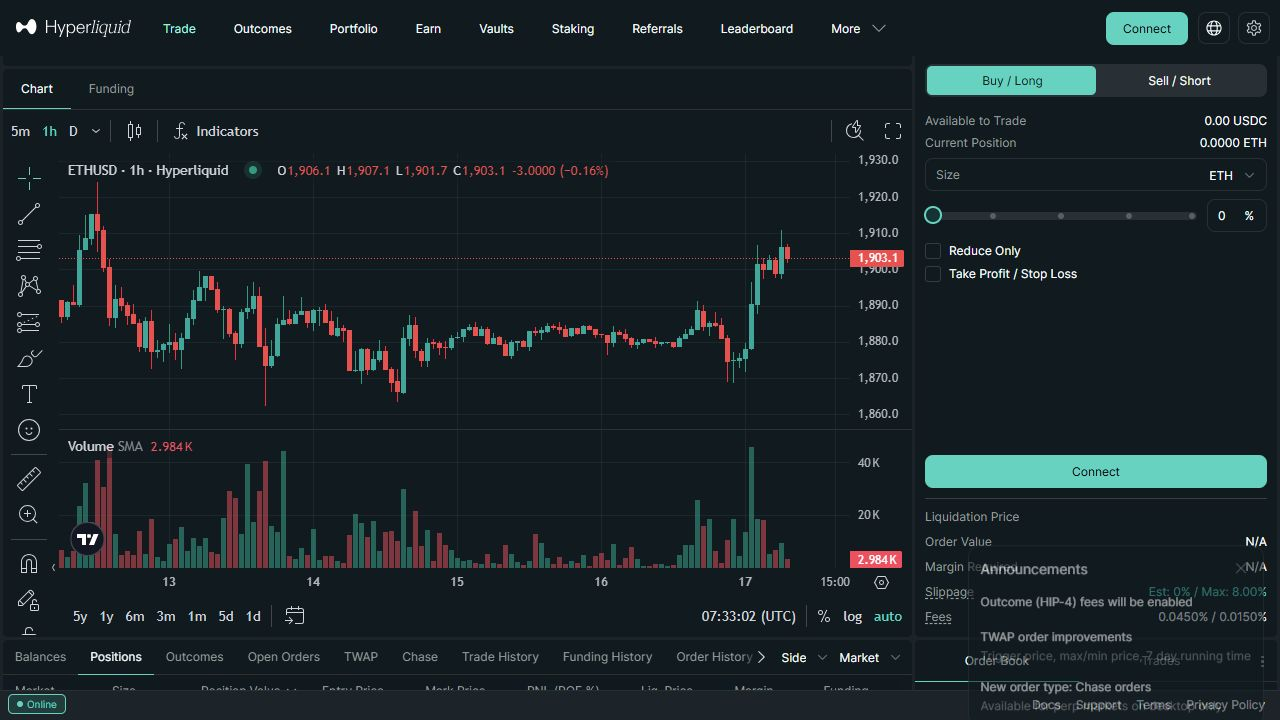
The public Hyperliquid trading interface shows this sequence in one screen: a chart and current market sit beside long/short controls, size, reduce-only, take-profit/stop-loss and liquidation fields. Interface clarity does not remove protocol or market risk, but it makes the state transition easier to inspect before signing.
How funding keeps perpetual futures prices near spot
A dated futures contract converges toward its settlement value as expiration approaches. A perpetual has no equivalent deadline, so exchanges need another force to discourage a lasting gap between the derivative and the underlying index. Funding performs that role by transferring value between the two sides of the market rather than charging a conventional interest payment to the exchange.
When the perpetual trades above the index, funding is commonly positive and long positions pay short positions. When it trades below the index, funding can turn negative and shorts pay longs. The direction creates an incentive to take the less crowded side, but it does not guarantee immediate convergence. Liquidity, positioning and volatility can keep the basis open between settlements.
The Coinbase International trading rules provide a concrete implementation: the index draws on external spot markets, while mark-price and premium inputs feed the funding process. Other venues use different intervals, clamps and formulas, so the displayed rate must be read with its schedule. Coinwy’s report on a funding-limit change shows why a current contract parameter is more reliable than an old screenshot or assumed standard.
Spot, index, mark and last price explained
Four prices can appear around the same contract. Spot is the cash-market price on an individual venue. An index combines or filters reference prices to represent the underlying market. Last price is the latest perpetual trade. Mark price is a venue-defined fair-value estimate used for risk calculations, commonly including index and basis information.
| Price | Comes from | Typical role | Main limitation |
|---|---|---|---|
| Spot price | A cash market | Buying or selling the asset itself | One venue may diverge temporarily |
| Index price | A basket or reference methodology | Underlying benchmark | Depends on constituent quality and fallback rules |
| Last price | Most recent perpetual trade | Chart and recent execution | A single print can be noisy |
| Mark price | Venue fair-value method | Unrealized PnL and liquidation | Method differs across platforms |
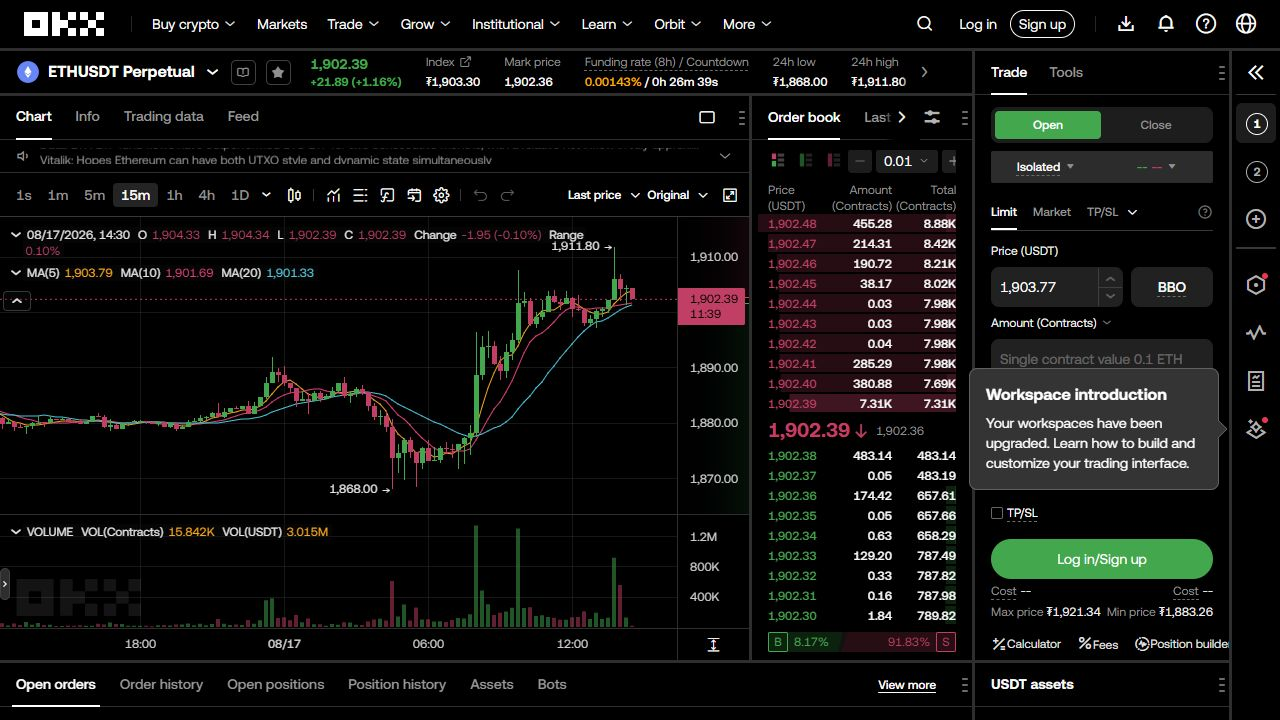
This distinction matters near liquidation. A chart can show the last trade while the risk engine watches mark price. The OKX ETH perpetual screen displays index, mark and funding together, separating execution from risk inputs.
The distinction also explains why a manipulated or unreliable reference feed can threaten a protocol even when the visible chart appears normal. Coinwy’s coverage of the Ostium oracle-manipulation incident illustrates the wider dependency: a perpetual system needs defensible reference pricing as well as a functioning trading interface.
How profit and loss work for long and short positions
A long position gains when the contract rises above entry and loses when it falls. A short does the reverse. For a simple linear contract, gross PnL is position quantity multiplied by the difference between exit and entry prices, with the sign reversed for a short. Fees, funding and price impact then change the net result.
Consider a 1.5 ETH long entered at $2,000. Its notional exposure is $3,000. If the position closes at $2,080, the $80 move produces $120 in gross profit: 1.5 x ($2,080 - $2,000). If it closes at $1,920, gross loss is $120. The result does not depend on whether the trader posted the full $3,000 as margin; leverage changes the required collateral and loss buffer, not the dollar exposure created by 1.5 ETH.
Inverse or coin-margined contracts use a different calculation because contract value and settlement are denominated in the underlying coin. That structure can make the collateral itself rise or fall alongside the position. A contract specification should therefore be read before a PnL example is reused across venues.
How margin, leverage and liquidation work together
Margin is collateral reserved against losses. Initial margin is required to open the position, while maintenance margin is the lower boundary that must remain after price movement and costs. Liquidation begins when account equity no longer satisfies the venue’s maintenance rules; the exact trigger may also reflect risk tiers, fees and mark-price methodology.
Leverage describes exposure relative to margin. A $3,000 position backed by $1,000 of margin has 3x exposure, while the same position backed by $300 has 10x exposure. The market move produces the same gross PnL in both cases, but the smaller margin balance reaches its loss boundary sooner. That is why maximum leverage is a product limit rather than a recommended setting.
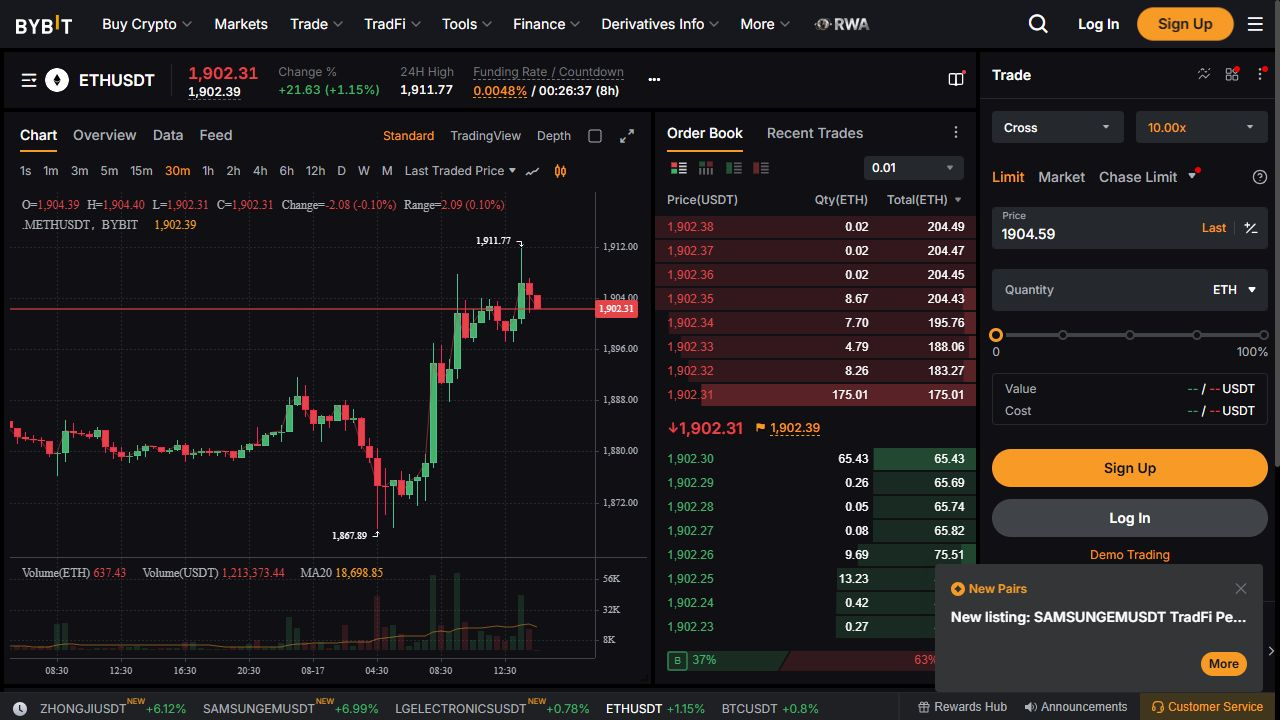
The Bybit ETH perpetual interface makes the relationship visible through contract quantity, cross-margin selection, leverage, order book and funding information. Cross margin can draw on a wider eligible balance; isolated margin confines the position to an assigned margin amount. Neither mode prevents a loss, and cross margin can expose more of the account when several positions move together.
Perpetual futures vs spot and dated futures
Spot ownership, expiring futures and perpetuals can all express a market view, but their cash flows are different. Spot gives direct asset ownership and no liquidation from leverage when bought without borrowing. Dated futures define a settlement month and can trade at a basis that converges into expiry. Perpetuals remove the roll date but replace it with recurring funding and continuous margin management.
| Feature | Spot | Dated futures | Perpetual futures |
|---|---|---|---|
| Asset ownership | Yes, when withdrawn to self-custody | No | No |
| Expiration | None | Fixed date | None |
| Alignment mechanism | Direct cash trading | Convergence at settlement | Funding plus index/mark methodology |
| Short exposure | Requires borrowing or another product | Native | Native |
| Margin and liquidation | Not for unlevered spot | Yes | Yes |
| Ongoing carry | Borrow or custody costs may apply | Basis and roll cost | Funding, fees and basis |
The CME comparison of spot exposure and futures reinforces the economic distinction: derivatives create price exposure without transferring the underlying asset, and their financing mechanism becomes part of the result. Coinwy’s article on perpetual futures as financial infrastructure takes the next step by examining why always-open derivatives markets matter beyond a single trade.
Stablecoin-margined vs coin-margined perpetuals
Linear USDT- or USDC-margined contracts show PnL in a stable quote currency without requiring the underlying asset as collateral. The trade-off is exposure to the stablecoin, venue rules and any conversion needed before withdrawal.
Coin-margined contracts settle in an asset such as BTC. A profitable short can earn more coin while the coin’s dollar price falls, which may suit a miner or holder managing coin-denominated inventory. The same structure complicates a directional long because both the position and collateral can lose dollar value together.
Pre-IPO and synthetic markets add another layer because the reference asset may not have a continuous public spot market. Coinwy’s coverage of Binance pre-IPO perpetual futures explains why a contract can provide price exposure without providing shares, voting rights or ownership of the referenced company.
Why traders use perpetual futures
Directional trading uses a long for bullish exposure or a short for bearish exposure. A holder can instead short a perpetual to reduce near-term spot exposure, although basis, funding and imperfect sizing can keep the hedge from matching the asset exactly.
Relative-value traders compare perpetual funding and basis with spot or dated futures. Market makers quote both sides and manage inventory. These uses depend on reliable execution, sufficient collateral and a venue that remains available through stressed conditions. They do not turn the contract into a guaranteed hedge or yield product.
| Use case | Position logic | Main operational dependency |
|---|---|---|
| Directional long | Gain from a higher contract price | Loss buffer and funding cost |
| Directional short | Gain from a lower contract price | Short squeezes and negative funding |
| Spot hedge | Short perpetual against a spot holding | Hedge ratio, basis and collateral |
| Basis trade | Hold opposing spot and derivative legs | Execution, funding and venue solvency |
| Market making | Quote bids and asks while managing inventory | Low latency, depth and liquidation controls |
The main risks of perpetual futures
Liquidation is the most visible failure, but it is usually the final step in a longer chain. A position can first lose through adverse price movement, funding, fees and slippage. Thin liquidity can make the exit materially worse than the displayed last price, especially when many leveraged positions try to close together.
Reference-price failure creates a separate risk. A stale index constituent, weak oracle or flawed fallback can distort mark price and margin calculations. Centralized venues add account, withdrawal and counterparty dependencies; onchain venues add wallet, chain, smart-contract, oracle and liquidity-pool dependencies. The perpetual DEX guide and centralized exchange comparison separate those operating models without treating either label as automatically safer.
Contract changes also matter. A venue may adjust leverage tiers, funding caps, collateral, index constituents or settlement rules, and a listing can be removed. Coinwy’s report on Binance perpetual-contract delistings shows the practical consequence: an open-ended contract has no scheduled expiry, but the platform can still end the market under its rules.
Conclusion
Perpetual futures are non-expiring derivatives that turn collateral into long or short exposure. Funding aligns the contract with a spot-based index, mark price supports PnL and liquidation calculations, and margin keeps the position active until it closes or breaches maintenance requirements.
The product is useful because it removes the expiry and roll schedule of dated futures, not because it removes cost or risk. A sound reading starts with the contract’s underlying index, settlement asset and price fields, then follows the complete path from order execution through funding, margin, close and collateral withdrawal.
FAQs
Do perpetual futures expire?
No. They do not have a scheduled expiration date, although a venue can delist or terminate a contract under its market rules. A position can remain open while margin requirements are met and the market remains available.
Do perpetual futures give ownership of crypto?
No. They provide derivative price exposure. A BTC perpetual position does not place BTC in the trader’s wallet and does not provide the ownership rights associated with the underlying asset.
Why do perpetual futures need funding?
Without expiry, the contract lacks a fixed settlement date that forces convergence with spot. Funding transfers value between longs and shorts to discourage a persistent gap between the perpetual price and its reference index.
Can a perpetual position be liquidated even when the last price never touched the liquidation price?
Yes. Many venues use mark price rather than the latest trade as the liquidation reference. Index methodology, maintenance margin, fees and account equity can also affect the trigger.
Disclaimer: This article is for informational purposes only and does not constitute financial or investment advice. Cryptocurrency and digital asset markets carry significant risk. Always do your own research before making decisions.